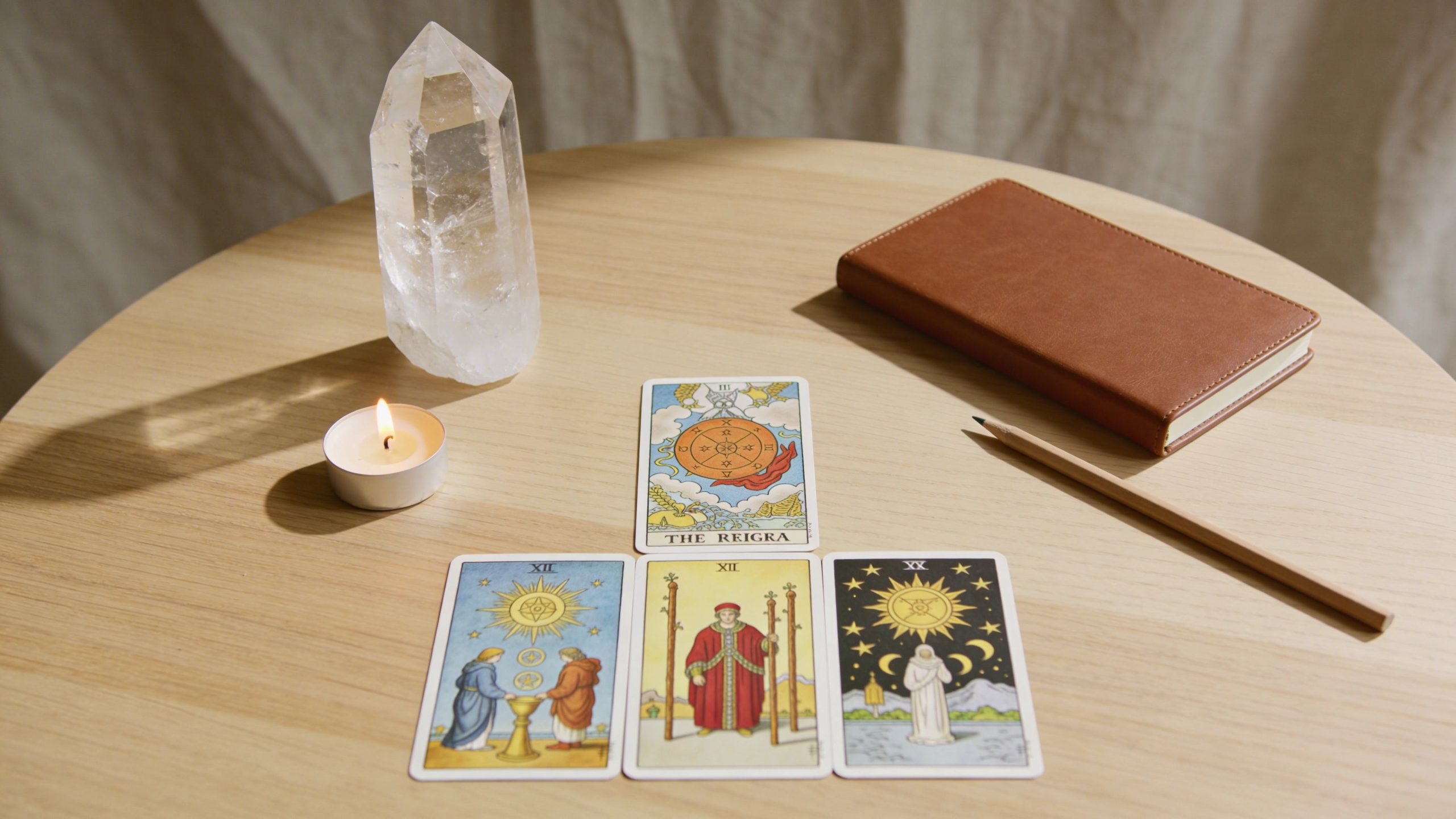
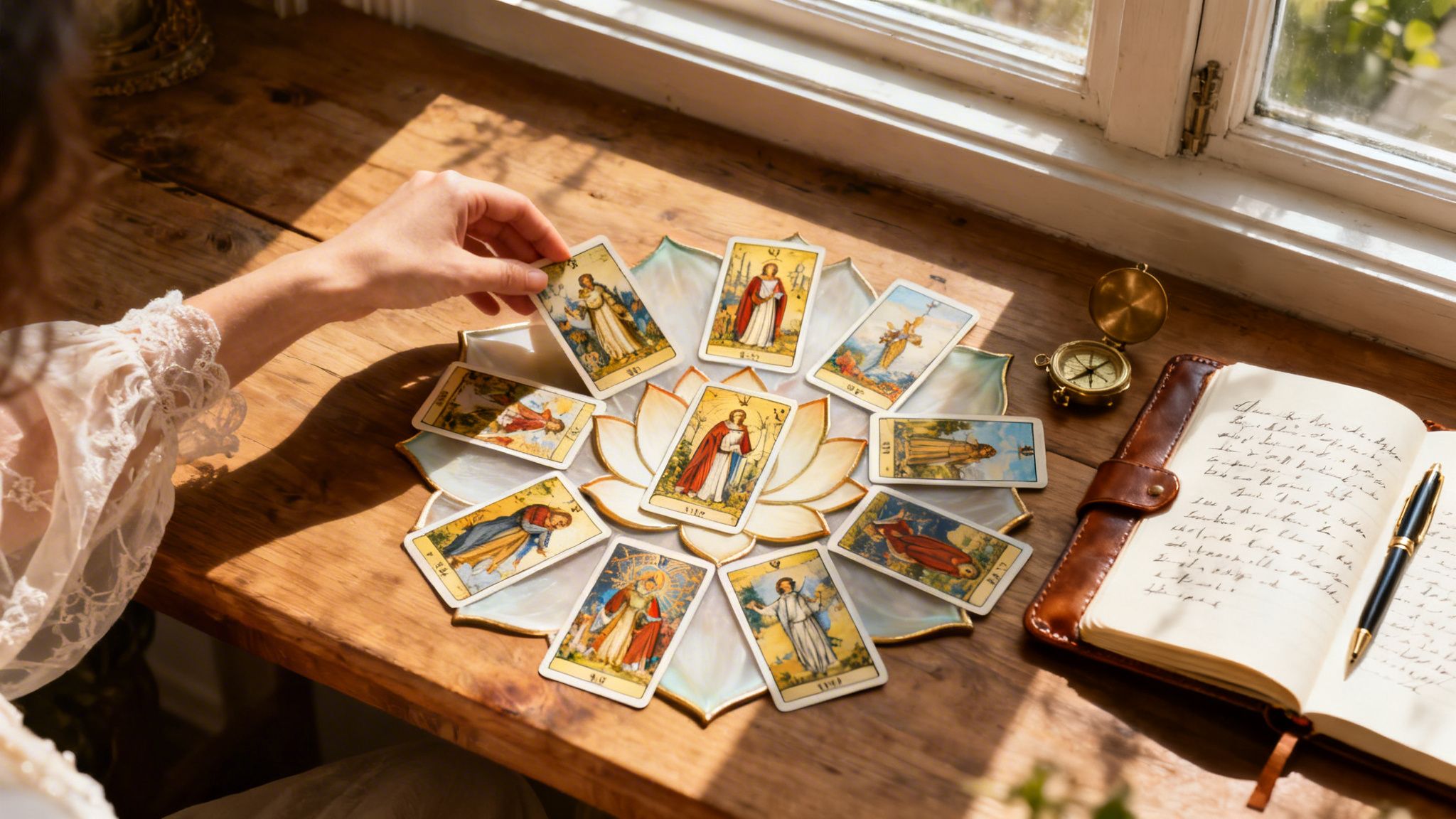
You shuffle, ask about your love life, and pull The Sun, Eight of Cups, and The Tower.
At first glance, that looks impossible. One card looks happy. One looks like walking away. One looks like chaos. If you're trying to learn tarot card meanings, this is the moment most beginners get stuck. You look up each card separately, get three different answers, and still don't know what the reading is saying.
That confusion is normal.
Tarot doesn't work like a dictionary where one card equals one fixed sentence. It works more like a conversation. One card sets the mood. Another card changes the direction. A third card explains why it matters. In love readings, that can mean a joyful connection that can’t continue in the same form. In career readings, it can mean success that arrives only after a sudden break from the old structure.
A lot of people try to memorize all 78 cards, but a reading becomes clear when you notice how the cards respond to each other. That’s the skill that turns tarot from a pile of keywords into something useful for real questions about relationships, work, timing, and emotional clarity.
You don't need to become mystical overnight. You need a way to read patterns calmly.
- Your First Step Beyond the Guidebook
- The Building Blocks of Your Tarot Toolkit
- Decoding the Major Arcana Your Soul's Journey
- Mastering the Minor Arcana Everyday Life Explained
- The Art of Card Conversations How Meanings Shift Together
- Your Quick Reference Guide for Common Questions
- Putting Your Knowledge into Practice
Your First Step Beyond the Guidebook
A beginner often does the same thing. She asks, “Does this person still love me?” Then she pulls three cards, searches each meaning, and ends up more anxious than before.
That happens because isolated definitions rarely answer a real-life question.
Take that earlier example. The Sun, Eight of Cups, and The Tower could sound contradictory if you read them one by one. Together, they tell a cleaner story. The connection may have brought real truth or warmth. But someone is leaving what no longer satisfies. The breakup, truth bomb, or emotional collapse may already be happening, or needs to happen so both people stop pretending everything is fine.
That's how tarot starts making sense.
Read for the sentence, not the word
Each card is like one part of a sentence.
- The first card often shows the main energy
- The second card adds action, tension, or motive
- The third card shows outcome, lesson, or what cannot stay hidden
If you only read “The Sun means happiness,” you miss the story. Next to difficult cards, The Sun can mean exposure. It can mean the situation is finally clear. In love, that can be healing. It can also be uncomfortable.
Tarot becomes easier when you stop asking, “What does this card mean forever?” and start asking, “What is this card doing here, with these other cards, for this question?”
That shift matters in love and career readings because most questions aren't abstract. They're urgent. “Should I stay?” “Will this job work out?” “Is this person serious?” “Why do I feel stuck?”
You don't need perfect memory to answer those questions. You need structure, context, and some trust in what you're seeing.
The Building Blocks of Your Tarot Toolkit
Before card combinations make sense, the deck itself has to feel less crowded. Tarot gets easier when you stop seeing 78 separate problems and start seeing a system.
The standard tarot deck has 78 cards, divided into the 22 Major Arcana and 56 Minor Arcana, with the suits of Wands, Cups, Swords, and Pentacles tied to fire, water, air, and earth, as explained in this overview of tarot structure and symbolism.
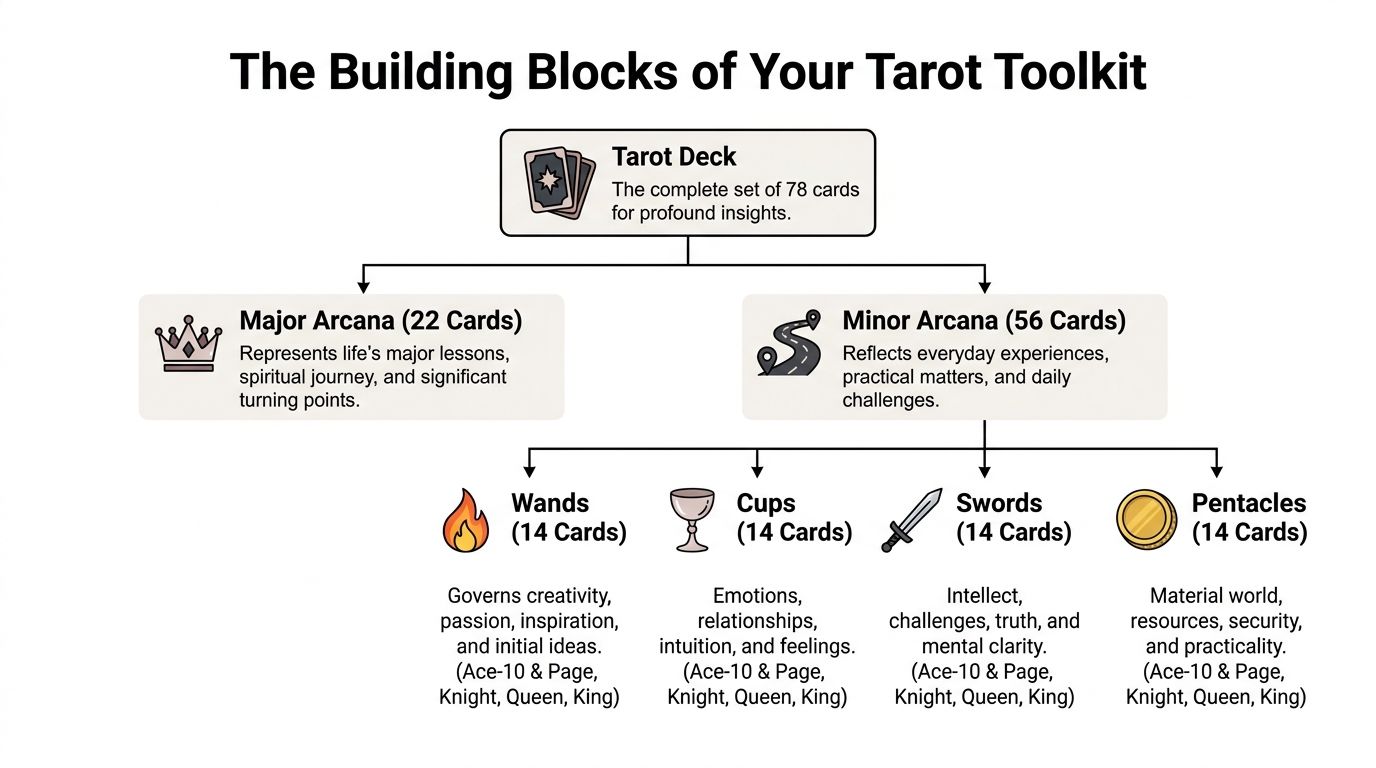
Major Arcana and Minor Arcana
Think of the Major Arcana as the big chapters of life. These cards show turning points, deep lessons, major choices, endings, awakenings, and spiritual pressure. When several Majors appear, the reading usually feels weighty.
Think of the Minor Arcana as daily life. They show conversations, moods, conflicts, plans, bills, attraction, fear, effort, timing, and practical reality. They fill in the details.
A simple way to remember it:
| Part of deck | What it often points to |
|---|---|
| Major Arcana | Big life themes, major lessons, defining moments |
| Minor Arcana | Everyday events, emotional states, practical details |
The four suits in plain language
Each suit has its own personality. Once you know the suits, half the deck stops feeling random.
- Wands relate to action, desire, energy, creativity, and momentum. In love, they can show attraction and chemistry. In career, they often point to ambition and initiative.
- Cups deal with emotion, relationships, intuition, and vulnerability. These cards show how someone feels, what the heart wants, and where connection is flowing or blocked.
- Swords speak through thought, truth, conflict, analysis, and stress. They often appear when someone is overthinking, protecting themselves, arguing, or facing a hard truth.
- Pentacles handle work, money, health, security, home, and what can be built over time. In career readings, Pentacles are especially important. In love, they ask whether the connection has substance.
Why suit dominance matters
If a reading is full of Cups, emotions are driving the situation.
If a reading is packed with Swords, the issue may be less about love itself and more about fear, confusion, boundaries, or painful honesty.
If Pentacles dominate a career reading, pay attention to stability, training, money, long-term growth, and whether the opportunity is realistic.
If Wands flood a spread, something wants movement. That's exciting, but not always stable.
A fast practice method
Pull one card a day and sort it before you interpret it.
Ask yourself:
- Is it a Major or Minor?
- If it’s a Minor, which suit?
- Does that suit point more toward feelings, thoughts, action, or practical reality?
- How does that match your actual question?
If you want a simple place to practice one-card interpretation, a one-card tarot draw is useful because it forces you to keep the reading focused.
Decoding the Major Arcana Your Soul's Journey
The Major Arcana are the cards people tend to remember first. They carry strong images and strong emotions. When one lands in a spread, it usually says, “Pay attention. This matters.”
The Rider-Waite-Smith deck, published in 1909, standardized imagery for the 22 Major Arcana and 56 Minor Arcana, and that structure influenced over 90% of contemporary decks, which is why these images feel familiar across so many tarot resources, as described in Tarot.com’s history of the tarot cards.
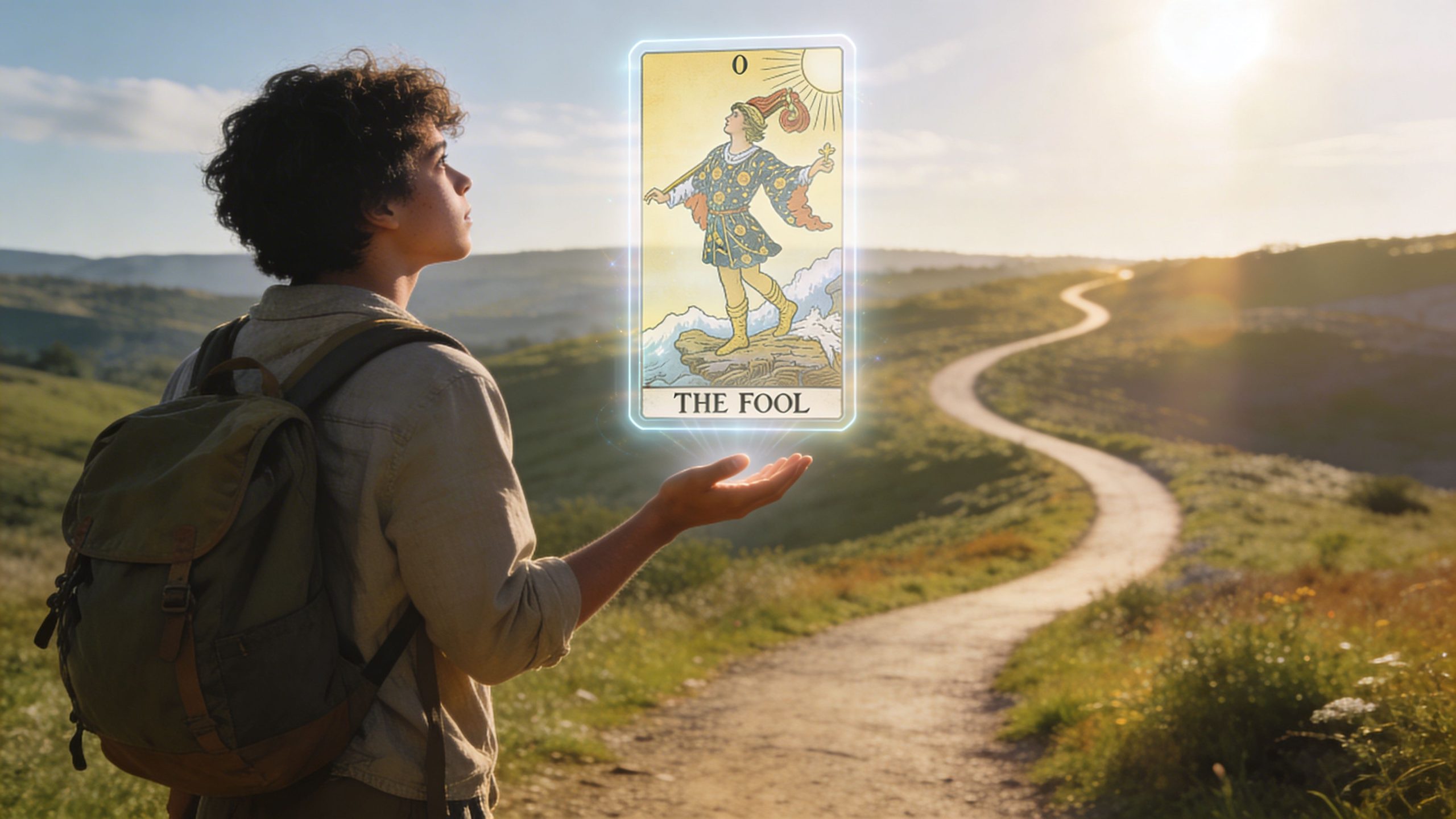
The Fool’s Journey in human terms
Readers often describe the Major Arcana as The Fool’s Journey. That sounds grand, but it’s practical.
The Fool is the part of you that begins. The World is the part of you that completes. In between, you meet discipline, love, fear, collapse, hope, mystery, and renewal.
Here’s a simple way to hold the sequence in your mind:
- Early cards show identity forming. The Fool, Magician, High Priestess, Empress, Emperor.
- Middle cards show relationships with rules, desire, conflict, sacrifice, and change.
- Later cards show deeper transformation. The Devil, The Tower, The Star, The Moon, The Sun, Judgment, The World.
You don't need to memorize a speech for each one. You need to recognize what stage of life energy you're looking at.
Major Arcana cards that show up a lot in love and career
Some cards come up constantly when people ask the questions they care about most.
The Lovers
Upright: alignment, attraction, choice, emotional truth.
Reversed: misalignment, avoidance, mixed values, disconnection.
In love, The Lovers doesn't always mean “soulmate.” Sometimes it means an honest choice must be made. In career, it can mean work that fits your values.
The Emperor
Upright: structure, authority, boundaries, leadership.
Reversed: rigidity, control, imbalance, power struggle.
In career readings, this often favors stable roles, management, systems, and long-term order. In relationships, it can show safety, but also emotional stiffness if paired with colder cards.
The Tower
Upright: sudden upheaval, truth breaking through, collapse of false structure.
Reversed: delayed rupture, resisting change, inner breakdown.
The Tower scares beginners. Fair enough. But it doesn't arrive to ruin your life for fun. It arrives where something can't stand as it is.
The Star
Upright: hope, healing, renewal, openness.
Reversed: discouragement, doubt, emotional distance.
After heavy cards, The Star is a breath. In love, it can mean healing after heartbreak. In career, it often says, “Don't give up. Rebuild with honesty.”
The Moon
Upright: uncertainty, intuition, illusion, emotional fog.
Reversed: confusion lifting, hidden fears surfacing, mixed signals still unresolved.
This card matters a lot in relationship questions. If you're asking, “Can I trust what I'm seeing?” The Moon often says, “Not fully yet.”
How to treat a Major Arcana card in a spread
When a Major appears beside Minors, read the Major as the headline and the Minors as the daily details.
For example:
- The Emperor + Three of Pentacles can point to building a career through discipline, teamwork, and mentorship.
- The Lovers + Two of Cups supports mutual feeling and emotional reciprocity.
- The Moon + Seven of Cups warns that fantasy may be louder than facts.
A short visual walkthrough can help if the archetypes still feel abstract.
A memory trick that works
If a Major Arcana card feels intimidating, ask one of these instead:
- Is this card about a choice?
- A truth?
- A collapse?
- A lesson?
- A healing phase?
- A completion?
That one question often narrows the meaning fast.
When a Major Arcana card appears, the reading usually isn't only about what happened this week. It's about what this moment is trying to teach you.
Mastering the Minor Arcana Everyday Life Explained
Most beginners fear the Minor Arcana because there are so many of them. But this allows tarot to become manageable.
You don't have to memorize 56 isolated definitions. You can read the Minors as a system. That matters because a classic 10-card Celtic Cross has approximately 4.55 quadrillion possible combinations, which is exactly why pattern-reading beats rote memorization, as shown in this mathematical breakdown of tarot spread combinations.
Read the number first
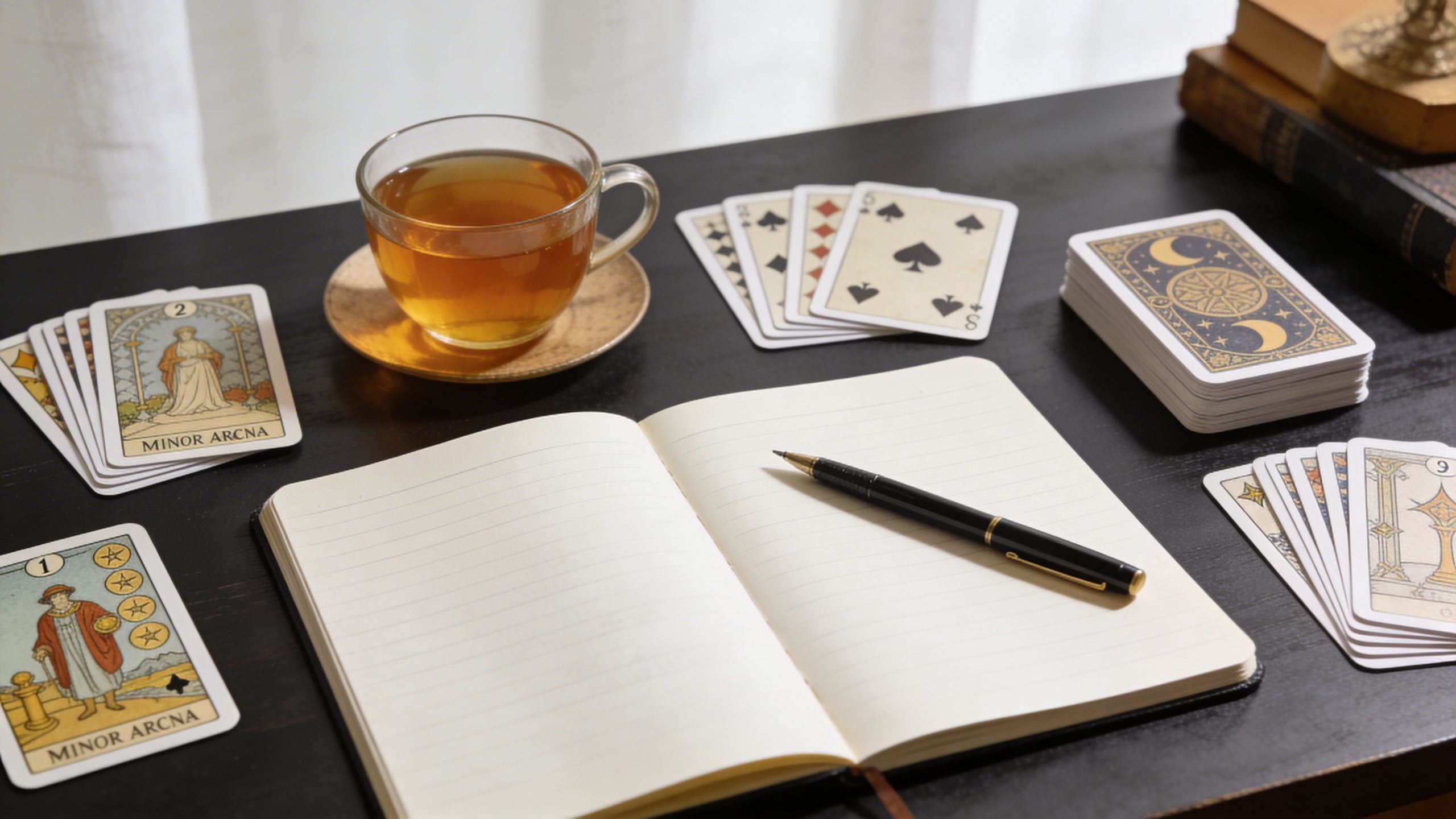
A Minor Arcana card is usually easier if you split it into number + suit.
The number gives the structure. The suit gives the area of life.
Here’s a practical cheat sheet:
| Number | Core idea |
|---|---|
| Ace | beginning, seed, opening |
| Two | choice, duality, balance |
| Three | growth, expression, development |
| Four | stability, structure, pause |
| Five | tension, disruption, change |
| Six | adjustment, movement, recovery |
| Seven | testing, strategy, reflection |
| Eight | progress, restriction, or concentrated movement |
| Nine | culmination, pressure, maturity |
| Ten | completion, ending, full cycle |
Once you know that, cards become less slippery.
Ace of Cups becomes an emotional opening.
Ace of Pentacles becomes a practical opportunity.
Five of Wands becomes active conflict or friction.
Ten of Cups becomes emotional completion or shared happiness.
Ten of Swords becomes a painful ending in thought, truth, or mental strain.
Use the suit to locate the issue
Let’s turn the same number through each suit.
Fives across the deck
- Five of Cups hurts emotionally
- Five of Swords shows conflict, ego, or mental battle
- Five of Pentacles feels like insecurity or lack
- Five of Wands looks like competition or scattered conflict
Same number. Different life area.
That means you’re not learning random cards. You’re learning a repeating language.
Court cards without panic
Court cards confuse almost everyone at first because they can represent people, personality traits, communication style, or the energy needed in the situation.
A simple hierarchy helps:
- Pages bring messages, curiosity, learning, early-stage energy
- Knights move. They chase, push, pursue, and act
- Queens contain and embody their suit inwardly
- Kings direct and stabilize their suit outwardly
Quick examples for love and career
Love
- Page of Cups can be shy affection, a sweet message, emotional openness, or an immature but genuine feeling.
- Knight of Wands can be exciting passion, but not always consistency.
- Queen of Cups often shows emotional intelligence, softness, receptivity, and deep intuitive awareness.
Career
- Page of Pentacles often points to study, training, a new offer, or learning by doing.
- Knight of Swords can show a fast-moving decision, blunt communication, or a rushed environment.
- King of Pentacles usually favors steady leadership, financial awareness, and tangible results.
Reversals without overcomplicating them
Reversed cards don't always mean “bad.” They often mean blocked, internalized, delayed, excessive, resisted, or unfinished.
For example:
- Ace of Pentacles reversed may suggest a missed opportunity, delay, or poor timing.
- Queen of Cups reversed may point to emotional overwhelm or weak boundaries.
- Knight of Wands reversed can warn against impulsive action.
Practical rule: If an upright card flows naturally, a reversed version often shows that same energy tangled, delayed, hidden, or overdone.
A journal prompt that sharpens your reading
When you pull a Minor Arcana card, write this sentence:
“The number says ____. The suit says ____. Together, this may mean ____.”
Examples:
Two of Cups
The number says connection and duality. The suit says emotion. Together, this may mean mutual feeling, attraction, or emotional meeting.Eight of Swords
The number says concentrated pressure or restriction. The suit says thought. Together, this may mean feeling trapped by fear or mental narratives.
That one habit helps you learn tarot card meanings much faster than staring at keyword lists.
The Art of Card Conversations How Meanings Shift Together
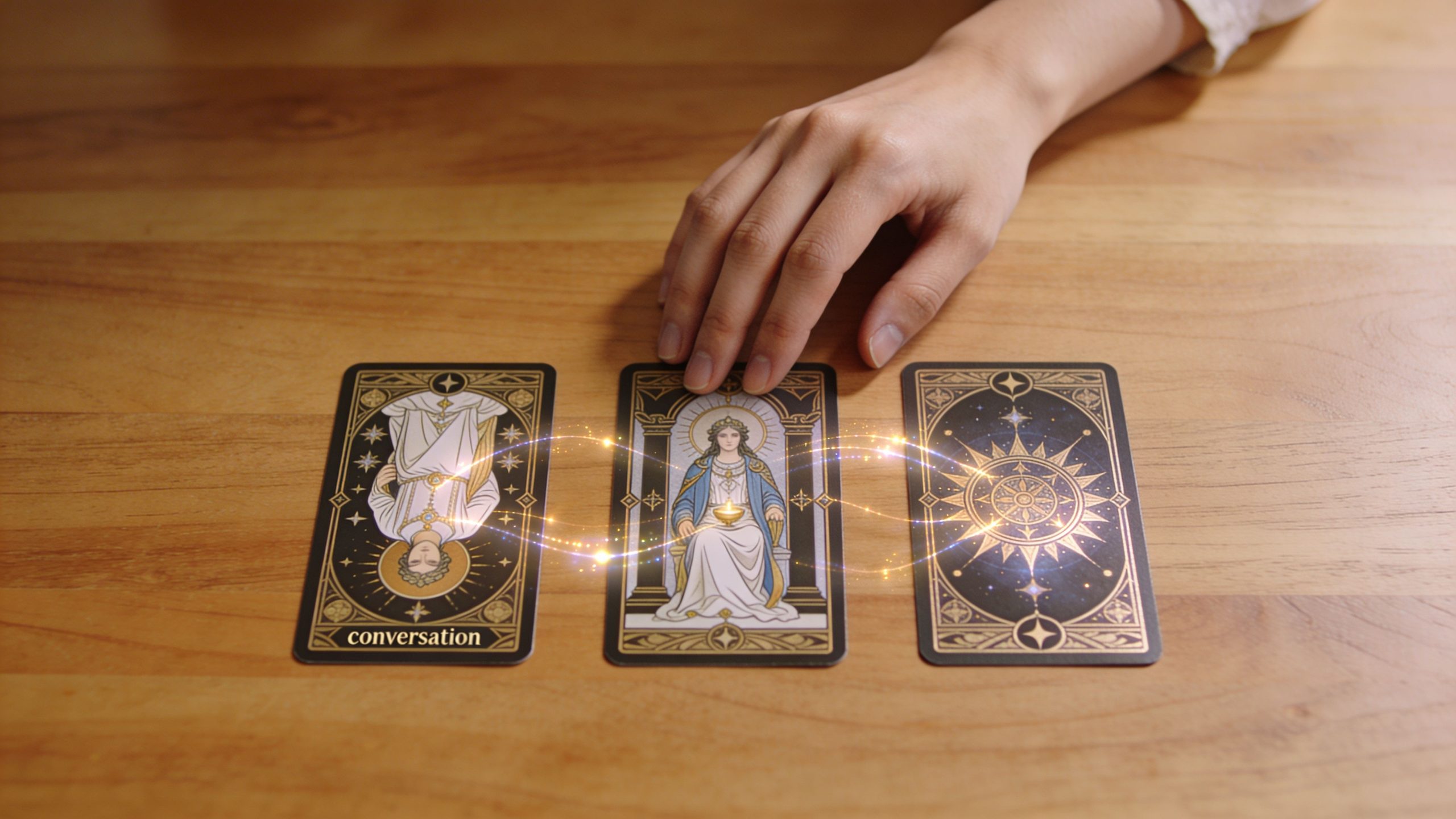
A reading then starts to feel alive. A card doesn't speak alone. It reacts.
You can think of combinations in three simple ways. Some cards reinforce each other. Some redirect each other. Some argue with each other.
Reinforcing combinations
These are easier to read because the cards lean in the same direction.
| Combination | Likely reading tone |
|---|---|
| The Lovers + Two of Cups | mutual attraction, emotional reciprocity, aligned bond |
| The Star + Ace of Cups | healing, emotional renewal, hope opening the heart |
| The Emperor + Three of Pentacles | stable career building, structure plus teamwork |
If you're reading for love and see The Lovers + Two of Cups, don't water it down unnecessarily. The cards support connection.
If you're reading for work and see The Emperor + Three of Pentacles, that often favors structure, collaboration, and building something solid under capable leadership.
Redirecting combinations
One card can then change the flavor of another.
Take Ace of Pentacles.
On its own, it's often a grounded opportunity. But:
- Ace of Pentacles + The Sun can suggest a visible success, confident start, or a practical opening that feels affirming.
- Ace of Pentacles + The Tower can show a new opportunity created by a sudden collapse, job loss, restructuring, or forced change.
Same first card. Completely different story.
Conflicting combinations
These combinations need care. Don't flatten them into a yes or no too fast.
Love example
The Empress + Five of Swords
The Empress wants nurture, abundance, warmth, and relational growth. The Five of Swords brings ego, tension, mind games, or conflict no one really wins.
Together, this can describe a relationship where love exists, but the communication style is corrosive. It can also describe one person trying to create harmony while the other keeps turning the connection into a battle.
Career example
The Sun + Ten of Wands
The Sun is visibility, energy, and clarity. The Ten of Wands is burden, overload, and carrying too much.
Together, this may mean success is real, but the workload is unsustainable. A promotion might look good from the outside while exhausting you.
A three-step combination method
When you're reading multiple cards, ask:
Which card leads?
Usually the strongest Major Arcana or the clearest emotional signal.Which card supports or challenges it?
This shows whether the first card flows, stalls, or gets distorted.What changes because these cards are side by side?
This is the heart of interpretation.
For quick practice, a three-card spread works well because it gives enough context to hear the conversation without overwhelming you.
Don't force harmony where the cards show tension. Good tarot reading isn't about making the answer prettier. It's about making it clearer.
Combination examples for common questions
“Does this person want commitment?”
- King of Pentacles + Four of Wands points more strongly toward steadiness and building.
- Knight of Wands + Seven of Cups leans toward excitement without grounded follow-through.
- The Lovers + The Moon may show real feeling mixed with uncertainty, secrecy, or inner conflict.
“Should I take this job?”
- Ace of Pentacles + Three of Pentacles supports growth through skill and practical collaboration.
- The Emperor + The Devil may warn that stability comes with control, pressure, or unhealthy power dynamics.
- The Star + Eight of Pentacles often supports patient rebuilding, craft, and long-term improvement.
This is the part many beginners miss. The cards don't just answer. They qualify the answer.
Your Quick Reference Guide for Common Questions
A lot of beginners don't need a long lecture in the middle of a stressful question. They need a fast way to orient themselves.
That matters because many readers want context-specific Yes/No guidance, especially for quick draws in love and career, and one cited trend says 40% of sessions are quick draws, as noted in this article about learning tarot without memorizing every card.
Quick reading table for love and career
| Card | Upright keywords | Reversed keywords | Love Yes/No | Career Yes/No |
|---|---|---|---|---|
| The Lovers | alignment, attraction, choice | misalignment, indecision | Yes if both are honest | Yes if values match |
| The Emperor | structure, authority, stability | rigidity, control | Maybe if warmth is missing | Yes for stable growth |
| The Moon | uncertainty, illusion, intuition | confusion lifting, mixed signals | No for clarity right now | Maybe. Verify facts |
| The Sun | joy, truth, confidence | delayed warmth, doubt | Yes | Yes |
| The Star | hope, healing, openness | discouragement, distance | Yes for healing bonds | Yes for recovery paths |
| The Tower | rupture, revelation, collapse | resisted upheaval | No for comfort as-is | Maybe if change is needed |
| Ace of Cups | new feelings, openness | blocked emotion, hesitation | Yes | Maybe. Better for passion than structure |
| Two of Cups | mutual connection, union | imbalance, disconnect | Yes | Maybe for partnerships |
| Eight of Cups | leaving, seeking deeper truth | reluctance to leave | No for staying the same | Maybe if you're ready to move on |
| Ten of Cups | emotional fulfillment, harmony | strain behind the image | Yes | Maybe. Better for team harmony than ambition |
| Knight of Wands | passion, motion, pursuit | impulsive, unreliable | Maybe. Strong attraction, less steadiness | Yes for momentum, not for patience |
| King of Cups | emotional maturity, calm | emotional suppression | Yes if feelings are steady | Yes for diplomacy and leadership |
| Ace of Pentacles | offer, foundation, growth | delay, missed chance | Maybe in love. Good if building slowly | Yes |
| Three of Pentacles | teamwork, skill, collaboration | poor coordination | Maybe in love. Effort is needed | Yes |
| Ten of Swords | ending, exhaustion, truth after pain | resisting closure | No | No, unless you're asking whether it's over |
| Five of Swords | conflict, ego, hollow win | remorse, unresolved tension | No | No |
| Page of Cups | tender message, curiosity | immaturity, emotional uncertainty | Maybe. Sweet but early | Maybe for creative roles |
| Queen of Cups | empathy, intuition, receptivity | overwhelm, porous boundaries | Yes | Maybe. Great for care work, less for hard structure |
| King of Pentacles | stability, provision, reliability | stubbornness, material fixation | Yes for grounded commitment | Yes |
| Seven of Cups | fantasy, options, projection | narrowing choices, reality check | Maybe leaning no | Maybe. Clarify before acting |
How to use the table without getting trapped by it
A Yes/No guide is a starting point, not a cage.
For example:
- The Emperor is a stronger yes for a question like “Will this job give me stability?” than for “Will this relationship feel emotionally expressive?”
- The Moon isn't always a hard no. It often means, “You don't have enough clarity yet.”
- Knight of Wands may be yes for attraction, but maybe for commitment.
Read the card in context of the actual question. That's what keeps your interpretation honest.
Putting Your Knowledge into Practice
You learn tarot card meanings the same way you learn a language. Not by staring at vocabulary lists forever, but by using them in real situations.
The most useful daily practice is simple. Pull one card in the morning. Write down your question or mood. Then come back that evening and ask, “Where did this card show up in my real life today?”
A routine that actually builds skill
Try this for a stretch of daily practice:
Ask one grounded question
“What energy should I work with today?” is enough.Name the card type first
Major or Minor. Then suit, if needed.Write one practical prediction
Not dramatic. Just specific.
Example: “If I pull Seven of Swords, I’ll watch for avoidance, mixed motives, or strategic thinking.”Review at night
Did the card show up in a conversation, mood, task, fear, or choice?
This practice matters because it teaches your own lived meanings. No book can fully replace that.
Why this works better than overstudying
If you only read definitions, tarot stays theoretical.
If you practice daily, the cards become personal. The Moon stops being just “illusion” and starts becoming that exact feeling you get when someone is vague and your intuition knows something is off. Three of Pentacles stops being a textbook teamwork card and starts becoming the day you and a colleague finally built something useful together.
A fuller spread can help once you're comfortable hearing those smaller signals. If you want to practice reading movement across time, a five-card past present future reading gives you room to compare how card meanings evolve from one position to the next.
The goal isn't to become a machine that recites card meanings. The goal is to become a reader who can notice what the cards are saying, in this moment, for this question, with compassion and honesty.
Keep it simple at first. Shuffle. Ask. Write. Reflect.
That's how confidence grows.
If you want to keep practicing with real spreads, Lotus Tarot Reading offers free on-demand tarot layouts for quick Yes/No pulls, love questions, career questions, and multi-card readings, along with beginner-friendly card meaning resources that help you keep building interpretation skills through repetition.