
You’re probably here because a question won’t leave you alone.
Maybe it’s love. You keep asking whether this relationship is deep and real, or just intense and confusing. Maybe it’s career. You’ve got a job offer, a side business idea, or a quiet urge to leave something that looks stable on paper. And every piece of advice sounds the same. Just trust your gut.
That sounds comforting, but it isn’t enough. More vague encouragement isn't helpful. What is needed is a way to tell the difference between intuition, fear, wishful thinking, and plain old stress.
As a tarot reader, I don’t treat intuition like a magical switch that some people have and others don’t. I treat it like a skill. Tarot helps because it gives your inner knowing something concrete to respond to. A card lands on the table, and suddenly the feeling in your body, the image in your mind, and the truth you were avoiding all become easier to notice.
Moving Beyond a Vague Gut Feeling
“Trust your gut” only works if you know what your gut is saying.
That matters because confidence in intuition isn’t the same as accuracy. A meta-analysis from the National Institutes of Health found no meaningful correlation between a person’s self-reported trust in their intuition and their actual performance in tasks requiring intuitive judgment (NIH meta-analysis). In plain language, people who strongly believed in their gut weren’t automatically better at intuitive decisions.
That finding relieves a lot of pressure. If you’ve felt disconnected from your intuition, it doesn’t mean you’re broken. It means intuition needs practice, feedback, and context.
Why blind trust often fails
People often confuse these four things:
- Fear: urgent, repetitive, loud
- Desire: attached to a specific outcome
- Projection: reading the past into the present
- Intuition: quiet, clean, direct
If you’ve ever asked, “Why do I keep getting a bad feeling about him?” or “Why does this new job look perfect but still feel off?” that is the work. Not blind belief. Discernment.
Tarot helps because it slows your reaction down. It turns a swirl of emotion into symbols, contrasts, and patterns you can examine.
A more grounded way to listen
I’ve found that people build trust in intuition faster when they stop demanding certainty and start gathering evidence from their own experience.
That includes paying attention to the body. Many people use the phrase “gut feeling” casually, but the body does give useful signals when you’re regulated and honest with yourself. If you’re exploring that side of intuition, a practical guide to good gut health can support the physical foundation for feeling more settled and responsive in your body.
Practical rule: Don’t ask, “Do I believe my intuition?” Ask, “How has my intuition behaved when I tracked it honestly?”
That shift changes everything.
Tarot isn’t just for predicting what happens next. It’s a mirror. It lets you test your impressions, name subtle dynamics, and see whether the same themes keep showing up in love, work, and personal choices. When used well, it becomes a training tool for how to trust your intuition without drifting into fantasy.
Learn to Recognize Your Intuitive Language
Intuition rarely arrives as a dramatic voice from the sky. It usually shows up as a body signal, an emotional tone, or a mental ping.

Harvard Kennedy School research found that systematic analytical thinking produced more accurate emotional inferences than pure intuition (Harvard Kennedy School research). That’s why I treat intuition as a starting signal, not the whole process. First notice it. Then check it.
Physical signals
The body often reacts before the mind can explain why.
A healthy intuitive signal usually feels like one of these:
- Expansion: your chest softens, your breathing deepens, your shoulders drop
- Contraction: your stomach tightens, your jaw locks, your posture closes
- Charge: a sudden chill, warmth, or tingling when something is true
For love questions, try this instead of overthinking: when you picture building a life with this person, does your body open or brace?
For career questions, notice the same thing. Does the thought of that role create steadiness and energy, or depletion and pressure?
Emotional signals
Emotions aren’t the enemy, but intuition has a different texture than emotional spiraling.
Look for:
| Signal | Usually feels like | Common meaning |
|---|---|---|
| Calm clarity | Quiet, simple, settled | Worth exploring |
| Subtle dread | Low, steady discomfort | Something may be off |
| Excitement with peace | Energized but grounded | Aligned opportunity |
| Panic | Urgent and repetitive | Fear needs regulating first |
Intuition is often quiet enough that anxious people talk over it and hopeful people decorate it.
That’s why timing matters. Don’t try to read your intuition when you’re activated, exhausted, or trying to force an answer.
Mental signals
Some intuitive messages arrive as thoughts, but they don’t sound like mental arguing.
They often come as:
- A sudden clear sentence: “This isn’t your person.”
- An image: you imagine yourself in that office and instantly feel heavy
- A simple nudge: call her, wait, leave, ask one more question
In tarot, this is the moment when a card lands and your first honest reaction says more than the guidebook.
Love and career examples
In relationships, intuitive language often answers the question beneath the question.
You may ask, “Does he love me?” but your body may be answering, “I don’t feel safe with inconsistency.” That’s important.
In career readings, you may ask, “Should I take this job?” but your intuition may be saying, “The pay is fine. The environment will drain you.”
Use this quick check:
- Love: Do I feel chosen, calm, and respected?
- Career: Do I feel stretched in a good way, or diminished?
- Friendship or family: Do I feel more like myself after contact, or less?
Anxiety tries to solve everything right now. Intuition usually offers one clean next step.
That’s the signal to trust.
Strengthen Your Intuition With Daily Practice
Reliable intuition grows from repetition. It doesn’t grow from wishing you were more spiritual.
Research on expert decision-making shows that masters in fields like chess develop reliable intuition through thousands of hours of practice, building a deep mental library of patterns (research on expert decision-making). Daily life gives you plenty of chances to build your own pattern library.

Start where the stakes are low
Don’t begin with “Should I leave my marriage?” or “Should I quit my job tomorrow?”
Start with small, testable impressions:
- Before checking your phone: guess who texted
- Before opening email: sense whether it’s good news, neutral news, or a request
- Before taking a route: predict which way will feel smoother
- Before a meeting: note whether the conversation will feel easy or tense
- Before seeing someone: write down the emotional tone you expect
You need feedback. Intuition becomes trustworthy when you compare what you felt with what happened.
Keep a simple intuition journal
Your journal doesn’t need to be poetic. It needs to be honest.
Try these prompts:
- Question: What am I sensing?
- Body: What do I feel physically?
- First impression: What was the first clear thought?
- Emotion: Am I calm, hopeful, scared, or attached?
- Outcome: What happened?
- Review: Was this intuition, bias, or stress?
After enough entries, patterns emerge. You may notice that your intuition is sharp when you’re rested and quiet, but muddy when you’re chasing reassurance.
Use creativity to soften mental noise
Some people can’t hear intuition because their minds are overcrowded.
Creative and reflective practices can help you become more receptive. Drawing, singing, free writing, drumming, walking without your phone, and sitting in silence all change the quality of your attention. If you want a spiritual framing for this, some readers find practices that raise your vibration useful because they encourage presence, emotional clearing, and steadier self-awareness.
Here’s a short practice I give often:
- Sit for a few minutes in silence
- Ask one question only
- Write the first answer without editing
- Wait
- Check later whether that answer still feels clean
A simple card spread can help with this. If you want a compact structure for daily reflection, a three-card reading is useful because it gives enough context to compare your initial instinct with a broader message.
Build review into the practice
The tendency is to record the hit and ignore the miss. That slows growth.
Use misses well:
- A fear-based miss: you wanted a warning, so you found one
- A wishful miss: you wanted a yes, so you softened obvious red flags
- A timing miss: the reading was accurate, but not immediate
- A symbol miss: you interpreted too concretely instead of thematically
A few minutes of guided centering can help you get into the right state before practicing:
The goal isn’t to become flawless. It’s to become familiar with your own signal. That’s how to trust your intuition in a way that feels grounded instead of dramatic.
Use Tarot as Your Intuition Training Ground
Tarot is one of the best tools for intuition training because it gives your inner knowing something visible to respond to.
Instead of asking tarot to hand you a fixed future, use it like a structured conversation. The card is the prompt. Your reaction is the data. The pattern over time is the lesson.
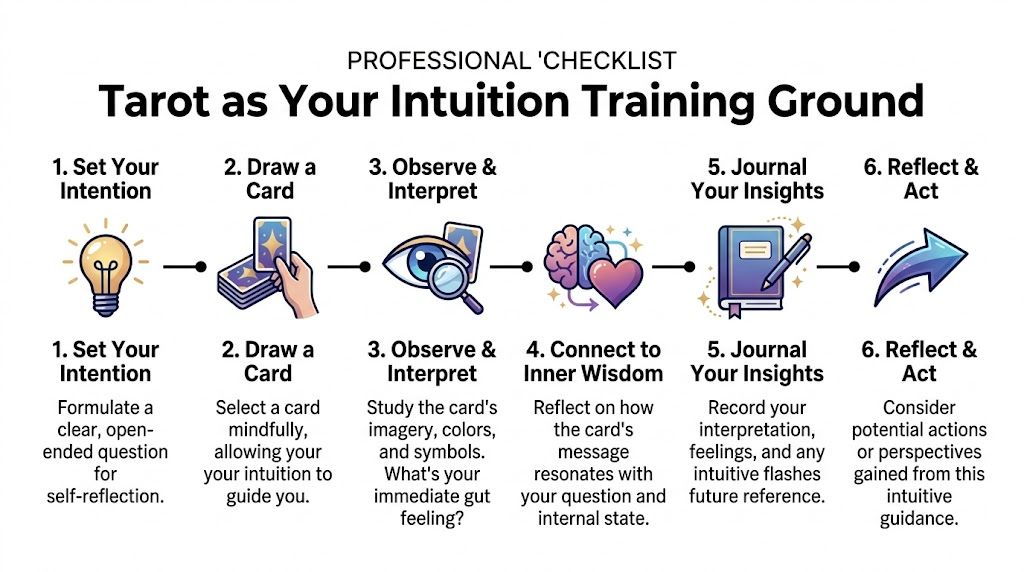
Spiritual and psychological guides recommend tracking intuitive hits to build empirical trust. One useful protocol is to note your feeling after a tarot reading and then review it after 30 days to see how your intuitive hits lined up with real outcomes (guidance on tracking intuitive hits).
Use one-card pulls as intuitive flashcards
A one-card pull is excellent for daily training.
Ask questions like:
- What energy am I missing in this relationship?
- What do I need to understand about this job offer?
- What am I not admitting to myself today?
A simple one-card tarot reading works well when you want to catch your first reaction before your analytical mind takes over.
Pay attention in this order:
- First body response
- Immediate emotional tone
- Image that stands out
- Traditional meaning after your own impression
That order matters. If you read the formal meaning first, you may talk yourself out of the truth you noticed instantly.
Read combinations, not isolated cards
Many beginners often get stuck here. They know one card meanings, but real answers come from how cards interact.
A strong card can support, soften, challenge, or expose another card. That interplay is where intuition sharpens.
Here are examples for the questions people ask most.
Love combinations that deserve a second look
The Lovers with Five of Swords
There is genuine attraction or a meaningful bond. But conflict, ego, poor communication, or unhealthy winning dynamics contaminate the connection. If you pulled this asking, “Is this soulmate energy?” the answer is more nuanced. The pull is real. The dynamic may still be damaging.
Two of Cups with The Moon
Strong emotional connection is present, but confusion sits around it. Someone may be idealizing, hiding, avoiding, or not seeing clearly. In dating, this often describes chemistry without clarity.
The Devil with Queen of Cups
One person may be deeply loving, empathic, and emotionally available, while the bond itself has attachment, obsession, dependency, or temptation mixed in. This combination often appears when a caring person is over-giving in a connection that keeps them hooked.
Ten of Cups with Four of Pentacles
The potential for happiness exists, but someone is guarding their heart, their money, their status, or their vulnerability. In long-term relationship questions, this can show a couple who wants stability but fears opening fully.
Career combinations that cut through confusion
The Fool with Eight of Pentacles
A new path has real promise, but it still requires skill-building, patience, and craft. This is a good sign for starting over, freelancing, retraining, or launching something meaningful. The excitement is valid, but it needs disciplined work.
Three of Wands with The Emperor
Expansion is available through structure. A business can grow, a promotion can happen, or a leadership role can stabilize. This pair likes planning. It does not reward chaos.
The Tower with Six of Swords
A disruption is clearing the path for transition. If you asked whether to leave a draining job, this pair often confirms that the shake-up is part of the exit. It may not feel graceful at first, but movement is necessary.
Wheel of Fortune with Seven of Cups
Opportunity is opening, but distraction is high. Too many options can cloud judgment. In career readings, this often means the timing is active but your discernment must sharpen before you commit.
Tarot doesn’t replace your intuition. It gives your intuition better questions.
A practical reading method for relationship and work questions
Use this sequence when you want an answer that feels useful, not theatrical:
| Step | What to do | What to notice |
|---|---|---|
| Ask | Keep the question specific | Avoid yes/no if the situation is layered |
| Draw | Pull one to three cards | Watch your first reaction |
| Record | Write what you felt before looking up meanings | This captures your real signal |
| Interpret | Read card interaction, not just each card alone | Look for tension, support, contradiction |
| Review | Revisit later | Track what proved accurate |
For love, ask about dynamics rather than fantasy. “What is the true energy between us?” works better than “Will he text me tonight?”
For career, ask about fit and direction. “What am I not seeing about this opportunity?” is stronger than “Will I be successful?”
The more sincerely you read, the more tarot stops feeling like random symbolism and starts feeling like a disciplined mirror.
A Practical Framework for Big Life Decisions
When the decision is big, intuition should not work alone.
A Fulbright research study on executive decision-making found that the most effective leaders act as “informed intuittants,” using gut feeling to form a hypothesis and then using data-driven approaches to verify it before acting (Fulbright research on executive decision-making).
That model works beautifully for personal life too.
The three-part check
I use a simple framework for decisions about love, career, relocation, and major endings.
First, gather the facts. What do you know? In a relationship, that means actions, consistency, communication, and shared values. In career, that means role expectations, finances, timing, workload, and risk.
Then, check your body.
When you sit calmly with Option A, what happens? When you sit with Option B, what changes? Don’t perform spirituality here. Just notice.
Then, consult a reflective tool.
A tarot spread can help you see what your mind is minimizing or romanticizing. For bigger crossroads, a clarity tarot reading can be a useful format because it encourages reflection rather than rushed prediction.
What this looks like in real life
Say you’re deciding whether to leave a steady job for a passion project.
On paper, staying looks safer. The income is predictable. The title is respectable. Other people approve.
But your body goes flat every time you imagine another year there. Then tarot brings up cards that point to risk, movement, or a new chapter. That doesn’t mean “quit tomorrow.” It means your intuition has raised a live signal.
Now you test it.
- Can you build savings first?
- Can you pilot the idea before leaving?
- Can you talk to people already doing the work?
- Can you set a review date instead of forcing an instant leap?
That is self-trust with structure.
The strongest decisions usually come when facts, body wisdom, and symbolic reflection point in the same direction, or when one of them exposes what the others are missing.
The same applies in love. If someone says the right words but your nervous system keeps bracing and the cards repeatedly show confusion, conflict, or imbalance, don’t dismiss that. Not every truth arrives as a spreadsheet.
Your Questions on Intuition Answered
How do I tell intuition from anxiety
Intuition is usually clean and brief. Anxiety repeats itself and demands certainty.
If you keep circling the same thought for hours, that’s usually not intuition. Step away, regulate your body, and come back later. The intuitive answer that remains after the panic settles is the one to examine.
What if my intuition seems illogical
Don’t obey it blindly, but don’t dismiss it because it isn’t convenient.
Treat it like a hypothesis. If your intuition says a relationship is off or a job isn’t right, look for supporting evidence. Reality often reveals the logic later.
Can intuition be wrong
Yes. Intuition can be distorted by fear, longing, projection, and unresolved pain.
That doesn’t mean you should stop listening. It means you should keep practicing, reviewing, and refining. A missed intuitive call is feedback. It shows you what your signal sounds like when it’s mixed with emotion.
What if tarot and my feelings don’t match
Pause before forcing an interpretation. Write both down.
Sometimes the mismatch shows denial. Sometimes it shows timing. Sometimes it shows that you asked the wrong question. Let the tension teach you instead of rushing to resolve it.
When you want gentle, on-demand support for love, career, and everyday clarity, Lotus Tarot Reading offers free readings you can use as part of your intuition practice. Pull a card, notice your first reaction, journal what it brings up, and let each reading help you build a more grounded relationship with your own inner wisdom.