Some seasons of life do not look dramatic from the outside. You still answer messages. You still go to work. You still say “I’m fine” when someone asks. But inside, something feels off.
You may feel it in love first. You keep asking whether this relationship is right, whether you are asking for too much, or why you cannot hear your own truth clearly. Or it shows up in career decisions. You scroll job listings, second-guess every option, and feel strangely detached from work you used to care about. Sometimes it is quieter than that. You just do not feel like yourself.
Learning how to reconnect with yourself is not about becoming a different person. It is about hearing your own inner voice again after stress, heartbreak, overwork, or emotional noise drowned it out. The most reliable path is not only mental. It involves the mind, the body, and the intuitive self together.
Recognizing the Signs of Disconnection
Disconnection often looks ordinary at first.
A woman asks about love and pulls cards every week, but every reading feels foggy because she is asking from panic, not clarity. Another asks about career, hoping for a clear sign to quit, stay, move, or wait. But beneath the career question is a deeper one. “What do I want now?”
That is the shape of disconnection. You are active, but not connected. You are making moves, but not making contact with yourself.

What it often feels like
Some signs are emotional. Some are practical. Many experience a mix.
- Love feels confusing: You cannot tell the difference between intuition and fear. You overread texts, ignore your needs, or keep returning to the same painful dynamic.
- Career feels flat or frantic: You feel restless in your current role, but every alternative seems equally wrong or equally exhausting.
- Your inner voice gets faint: You ask everyone else what they think before checking what you think.
- You live on autopilot: Days pass, tasks get done, but very little feels meaningful.
These are not signs that you are broken. They are signals that your inner relationship needs care.
Why this matters more than people admit
Disconnection is not a minor spiritual inconvenience. It affects health, resilience, and daily functioning. A landmark 1979 study found that people with strong social ties were 3 times less likely to die over a nine-year period than those with weaker connections, and later reporting shows over 25% of Americans have no one to confide in, reflecting a wider pattern of loneliness and distress (research summary and source).
That external loneliness often has an internal twin. Many are not only disconnected from others. They are disconnected from their own needs, limits, and desires.
Key takeaway: Feeling lost is not a character flaw. It is useful information. It tells you that your inner compass needs quiet, safety, and honest attention.
What helps and what usually does not
What helps is gentle structure. What usually does not help is forcing insight.
A few things I see fail again and again:
| Habit | Why it misses the mark |
|---|---|
| Constantly asking for reassurance | It can soothe you for a moment, but it weakens self-trust if used as a substitute for reflection |
| Pulling cards in a state of panic | The reading turns into emotional static |
| Trying to “fix yourself” in one weekend | Reconnection grows through repetition, not intensity |
| Waiting to feel certain before acting | Self-trust often returns after small honest actions, not before them |
The better approach is steadier. Ground the nervous system first. Listen to the body next. Then use reflective tools, including tarot, to turn vague feelings into usable insight.
Laying the Foundation with Grounding and Mindfulness
When your mind is racing, insight is hard to trust. Before you ask what the relationship means or whether you should change jobs, bring your body back into the room.

A 2022 study with 146 participants found that mindfulness practices supported self-reconnection by strengthening self-esteem and self-efficacy, especially through non-judgmental awareness and naming inner experiences clearly (study summary). In practical terms, that means when you stop fighting your feelings and start noticing them accurately, your sense of self gets stronger.
Start with box breathing
Box breathing is simple, and that simplicity is the point.
Try this for a few rounds:
- Inhale for 4
- Hold for 4
- Exhale for 4
- Hold for 4
Keep your shoulders relaxed. Let the breath move lower into your torso instead of staying high in the chest.
This is useful before a difficult conversation, before a reading, or when your thoughts start spiraling around a love or career question.
Use the 5 4 3 2 1 method when your thoughts scatter
This method works well when your mind keeps jumping ahead.
Notice:
- 5 things you can see
- 4 things you can touch
- 3 things you can hear
- 2 things you can smell
- 1 thing you can taste
This is not a performance. Do it slowly. The aim is not to impress yourself with spiritual discipline. The aim is to return to the present.
If you want more practical variations, this guide to grounding techniques for anxiety is useful because it stays concrete and easy to apply in daily life.
Name the state you are in
A brief sentence can change the quality of your awareness.
Try one of these:
- “I feel pressured.”
- “I feel lonely and I want clarity.”
- “I feel excited, but also afraid.”
- “I feel numb, and I need to slow down.”
When people skip this step, they often go straight into interpretation. That is where confusion starts. If you do not name your state, you can mistake fear for intuition.
A short guided practice can help if you struggle to settle your attention. This one is a good place to begin:
What grounding does for love and career questions
Grounding does not answer the question for you. It changes the quality of the answer you can hear.
In love, grounding helps you tell the difference between longing and compatibility. In career, it helps you separate urgency from alignment. Without that pause, you can chase chemistry that feels unsafe or accept work that pays well but slowly empties you.
Practice rule: If you feel desperate, flooded, or mentally noisy, ground first and interpret later.
That single rule will improve the quality of your decisions more than many anticipate.
Engaging Your Inner World Through Somatics and Journaling
Once you are calmer, listen beneath the thoughts. The body often tells the truth before the mind catches up.
Many people try to journal their way out of disconnection while their shoulders are tight, jaw clenched, stomach guarded, and breath shallow. That usually produces clever writing, not honest writing. Start with the body.
Release tension before you ask deep questions
Embodied reconnection practices work through the nervous system. Slow diaphragmatic breathing supports the parasympathetic “rest-and-digest” state, and consistent practice has been associated with Heart Rate Variability improvements of 15% to 25% within 8 weeks, a marker linked to emotional integration and clearer self-perception (supporting explanation).
You do not need a complex routine. Try this short sequence:
- Unclench the jaw: Open and close the mouth gently a few times.
- Drop the shoulders: Lift them toward the ears, then release.
- Lengthen the exhale: Breathe in naturally, then exhale a little longer than you inhaled.
- Place a hand on the chest and one on the stomach: Notice where you feel strain, pressure, emptiness, or warmth.
- Stand and shake out the arms: A brief physical reset often loosens emotional rigidity too.
Ask body-first questions
Instead of starting with “What should I do?” begin with “What is my body already telling me?”
For love:
- Where do I tense when I think about this person?
- What does emotional safety feel like in my body?
- Do I feel expanded, contracted, restless, or soothed after spending time with them?
For career:
- Which tasks make my energy rise naturally?
- What kind of recognition do I want?
- When I imagine saying yes to this opportunity, does my body feel heavier or steadier?

Journal in a way that reveals, not performs
A useful journal entry is specific, slightly uncomfortable, and honest enough that you would not post it online.
Try prompts like these.
Prompts for love clarity
- What am I hoping this person will give me that I have not been giving myself?
- Which red flags do I keep renaming as “potential”?
- What does a supportive partnership require from me, not only from them?
- When do I feel most like myself in love, and when do I disappear?
Prompts for career clarity
- Which part of my current work drains me fastest?
- What kind of recognition do I want?
- What am I afraid will happen if I choose the path that fits me better?
- Which strengths feel natural enough that I forget I am using them?
Prompts for self-trust
- Where am I asking for permission instead of making a choice?
- What truth have I already known for a while?
- What would I do next if I did not need to justify it to anyone?
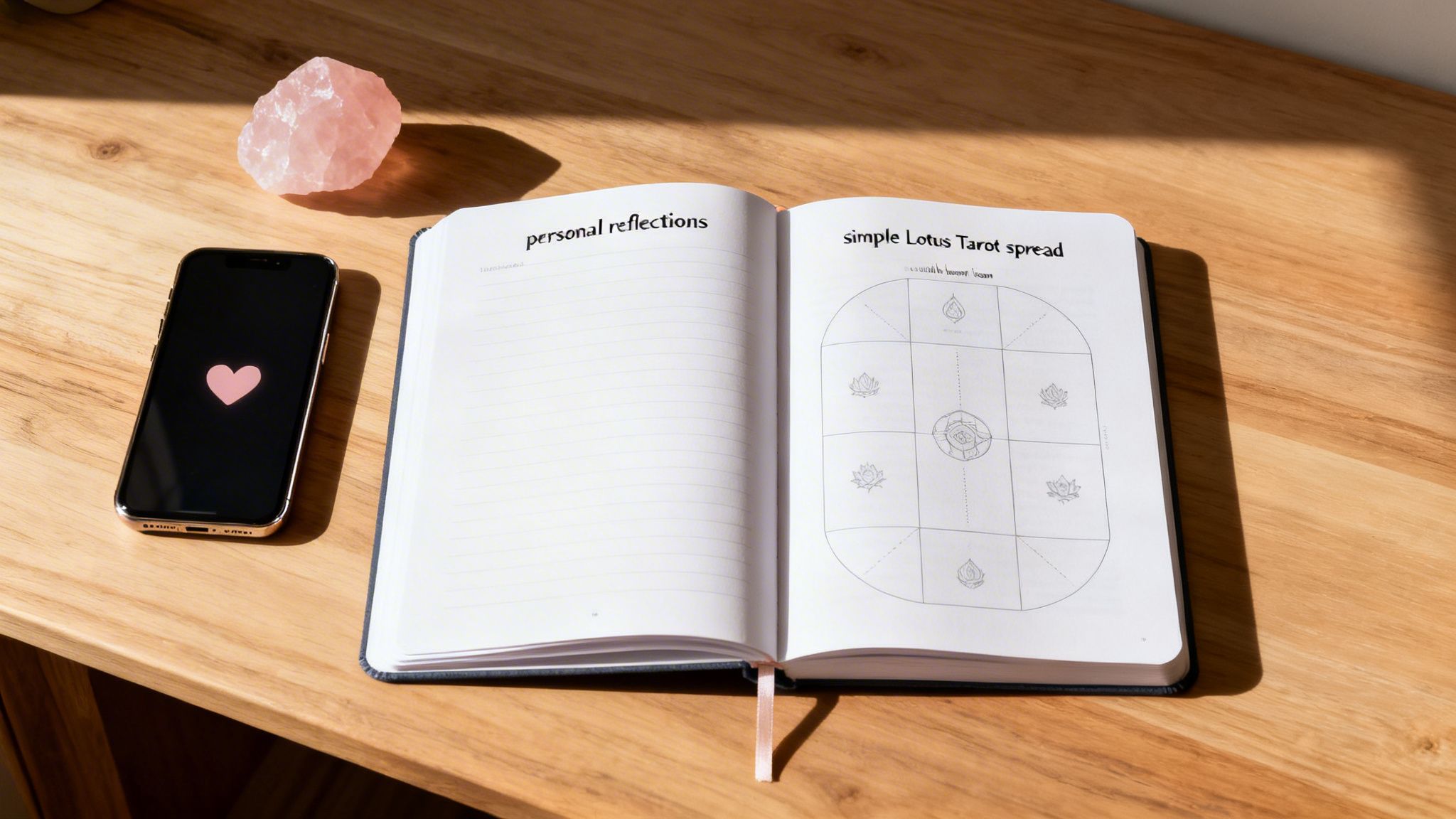
A short tarot spread can help after journaling, not before. If you want a compact format for checking the past, present, and likely direction of a situation, a 3 card tarot reading can work well after you have already named what you feel.
Tip: Journal after a somatic reset, not during peak overwhelm. Your answers become less dramatic and more accurate.
What works better than “positive thinking”
Forced positivity usually blocks reconnection. It asks you to rise above your feelings too quickly.
A better pattern looks like this:
| Less helpful | More helpful |
|---|---|
| “I shouldn’t feel this way” | “I do feel this way. What is it showing me?” |
| “I need the perfect answer today” | “I need one honest next step” |
| “I must stop overthinking” | “I need to notice what my body does when I think about this” |
That shift may seem small, but it changes the whole conversation you have with yourself.
Using Tarot as a Mirror to Your Soul
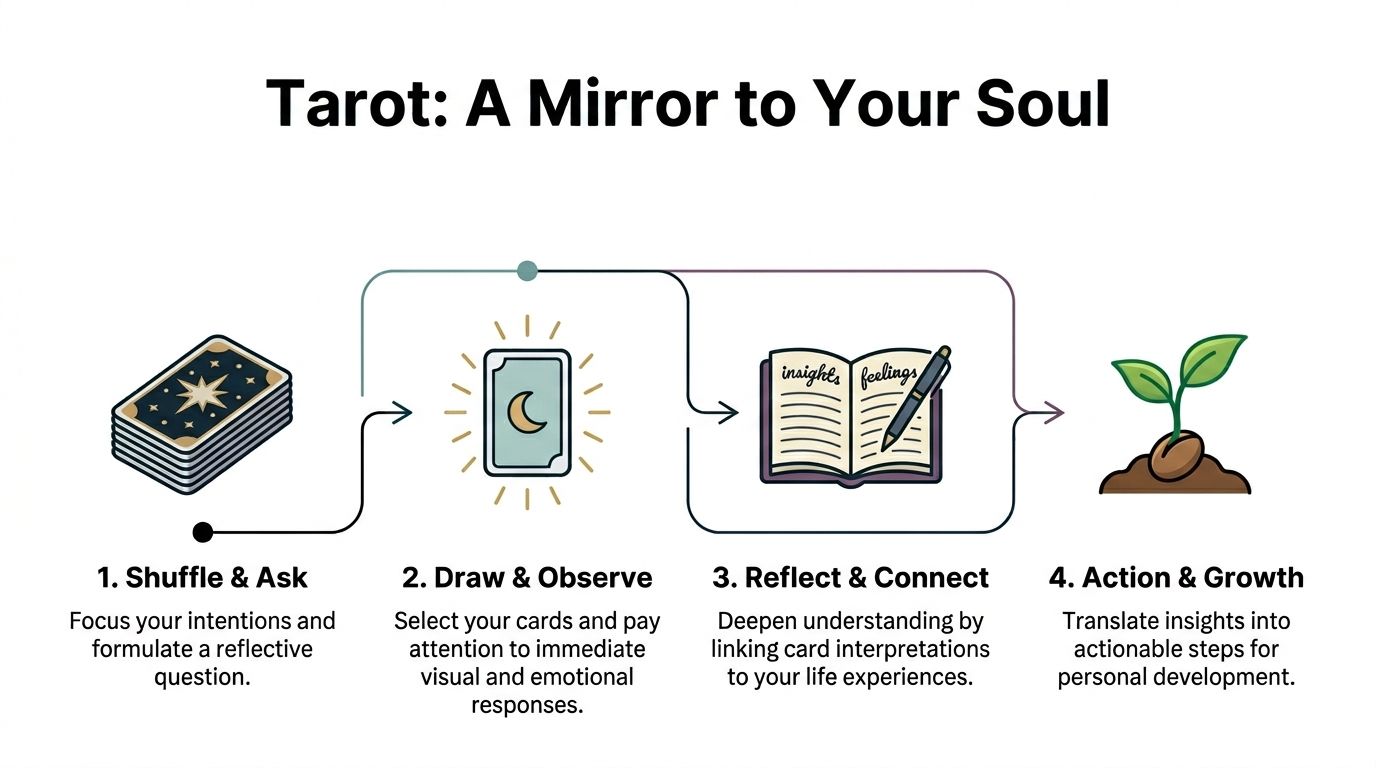
Tarot is most useful when you stop treating it like a machine for certainty and start treating it like a mirror. A good reading does not replace your inner voice. It sharpens it.
That is why tarot can be powerful for people who feel lost in love, stuck in career decisions, or emotionally disconnected from themselves. It gives shape to what is half-felt and half-known.
A 2024 pilot study reported that people using Polyvagal-informed tarot rituals had 35% higher self-clarity scores than those using standard mindfulness alone, and the same source notes 42% of those dealing with burnout-driven disconnection seek quick intuitive guidance that traditional methods do not always provide (supporting source).
The practical point is simple. Tarot can help when meditation alone leaves you floating in abstraction.
Ask reflective questions, not courtroom questions
Tarot responds better to honest inquiry than to interrogation.
Less useful questions:
- “Does he love me, yes or no?”
- “Will I get the job?”
- “When will my life finally change?”
More useful questions:
- What am I not seeing clearly in this relationship?
- What pattern am I repeating in love?
- What energy surrounds this career path?
- What would help me move from confusion to grounded action?
One-card readings are especially useful when you want a focused mirror instead of a flood of information. A simple one card tarot reading can help you check the emotional tone of the moment before you build a larger spread around it.
A spread for relationship crossroads
Use four positions:
- My current emotional truth
- What I may be avoiding
- What this connection is teaching me
- What action supports my self-respect
This spread is excellent when love feels charged, confusing, or addictive.
Here is where card combinations matter. Single-card meanings can be too flat for real life.
When The Lovers appears with The Devil
This combination often points to powerful attraction mixed with attachment, temptation, or an unhealthy bond. It does not automatically mean the relationship is doomed. It asks whether desire is overruling discernment.
In plain language, you may be drawn to someone while also losing your center around them. The core question becomes, “Is this love, compulsion, or both?”
When The Two of Cups appears with the Moon
This can show genuine emotional connection wrapped in uncertainty, projection, or incomplete information. The bond may be real, but the story around it may still be foggy.
That is common in early romance, long-distance connections, or on-again-off-again situations where feelings are strong but clarity is weak.
When Queen of Cups appears with Strength
This pairing supports emotional maturity. It often suggests that tenderness and boundaries can exist together. If you pull this while asking whether to speak directly, the answer often leans toward calm truth, not emotional collapse.
Love reading tip: The more “strong” the chemistry cards are, the more carefully you should check for safety, reciprocity, and consistency.
A spread for career path clarity
Use five positions:
| Position | Purpose |
|---|---|
| Current energy | How you feel in your working life now |
| Hidden block | What is interfering with clarity |
| Transferable strength | What you can trust in yourself |
| Wise next move | The next practical step |
| Likely outcome if you stay conscious | The direction this path takes with awareness |
This spread works well when you are deciding whether to stay, leave, apply, negotiate, or pivot.
When The Tower appears with The Star
This combination can frighten people at first, but it is often honest and helpful. The Tower shows disruption, collapse, or a false structure falling away. The Star brings healing, faith, and a cleaner future.
In career readings, this often means the old setup cannot hold. But the breakdown is making room for a truer direction. A layoff, resignation, or identity shake-up may become the event that returns you to meaningful work.
When The Emperor appears with the Eight of Pentacles
This combination often supports disciplined growth. It suggests skill-building, structure, and steady authority. If you ask whether to commit to a path, this pair often says yes, but not passively. It asks for consistency.
When The Moon appears with the Seven of Cups
This is a warning against career fantasy. You may be chasing image, title, or imagined freedom while avoiding hard facts. If this pair appears, gather information before making a leap. Intuition matters, but so does reality testing.
How to use the cards without becoming dependent on them
Tarot becomes unhealthy when every feeling requires a reading. It becomes wise when the cards support reflection, then release you back into your life.
A grounded rhythm looks like this:
- Pull cards after regulating your body, not in panic
- Write down your first reaction before checking meanings
- Ask what the card reflects in you, not only what it predicts outside you
- End every reading with one action you can take in ordinary life
Lotus Tarot Reading fits well as a practical tool. It offers on-demand spreads for love, career, and quick daily check-ins, which makes it useful when you want a structured reading format without overcomplicating the process.
Tarot is not there to tell you who to be. It helps you hear who you already are under pressure, longing, fear, and hope.
Rebuilding Your Life with Boundaries and Routines
Insight without structure fades fast. You can have a profound journal entry, a clear reading, and a sincere promise to yourself. Then one draining phone call, one guilt-laced text, or one chaotic workday pulls you right back out of center.
That is why boundaries and routines matter. They protect reconnection from being swallowed by old habits.
Boundaries are not distance from everyone
A healthy boundary is not isolation. It is an accurate relationship. Connection is protective. As noted earlier, strong social ties matter, and the same research summary shows a steep decline in close confidants for many people in the United States (supporting source). Reconnecting with yourself should not end in emotional withdrawal. It should help you choose better closeness.
Try these boundary scripts:
- “I need time to think before I answer.”
- “I can talk about this, but not while being pressured.”
- “I’m not available for last-minute work tonight.”
- “I care about you, and I still need to say no.”
Short is better. Overexplaining often signals guilt, not clarity.
Routines create emotional safety
People often resist routine because they fear becoming rigid. In practice, a small ritual creates steadiness. It reduces the daily negotiation that drains energy.
A useful reconnection ritual might include:
- Two minutes of breathing
- One card pull
- Three lines in a journal
- One practical intention for the day
For career questions, use that ritual before checking email or messages. If your work life is blurring into your personal life, this guide on how to maintain a healthy work-life balance can help you think more concretely about where your time and energy are going.
If your current concern is professional direction, a dedicated 5 card career tarot spread gives more room than a yes-or-no question. That extra space often reveals whether the issue is burnout, fear, timing, or a genuine mismatch.
What routines should protect
Your routine is not there to make you feel spiritual. It is there to protect specific things:
- Decision quality
- Energy
- Emotional honesty
- Time for reflection before reaction
Keep this standard: If a habit makes you more scattered, more dependent, or less honest, it is not supporting reconnection, even if it looks “self-aware” on the surface.
The goal is a life that does not constantly pull you away from yourself.
Embracing Your Ongoing Journey of Self-Discovery
Reconnection is not a final state you achieve once and keep forever. It is a relationship you maintain.
Some days you will feel clear quickly. Other days you will notice old confusion, people-pleasing, or emotional fog creeping back in. That does not mean you failed. It means you are human, and your practices matter.
A grounded path usually follows four movements:
- Ground through breath and mindfulness
- Inquire through body awareness and journaling
- Interpret through reflective tools like tarot
- Act through boundaries, routines, and honest choices
Structured reconnection practices that include emotional validation can reduce self-critical thought patterns by 30% to 40%, and structured reparenting rituals have been associated with 45% to 60% reductions in self-judgment, with retention above 80% at 12-week follow-up (supporting source).
That matters because harshness does not bring you home to yourself faster. It usually drives you further away.
If you feel lost in love, do not ask only, “How do I keep this person?” Ask, “Who am I becoming in this connection?” If you feel frozen in career, do not ask only, “What is the safest move?” Ask, “What choice lets me respect my energy, skills, and future self?”
Those are reconnection questions.
You do not need perfect intuition. You need enough stillness to hear yourself, enough honesty to accept what you hear, and enough courage to act on it in small real ways.
If you want a gentle place to begin, try a reading at Lotus Tarot Reading. Use it as a mirror, not a verdict. Ask one clear question about love, career, or your next step, draw the cards, and write down what feels immediately true.