Some nights you are not asking, “Do I love this person?” You are asking a harder question. “Can I build a life here without abandoning myself?”
That question usually shows up when the relationship looks decent from the outside. They text back. They say they care. Maybe your friends approve. Maybe nothing is obviously “wrong.” Yet your body still tightens when you imagine the future. Or you keep editing yourself to keep the peace. Or you feel lonely while lying next to someone.
If that is where you are, stop shaming yourself for having doubts. Doubt is not always sabotage. Sometimes it is wisdom knocking.
A lot of people stay stuck because they want certainty before they make a move. They want a cosmic green light, a flawless checklist, or one dramatic sign. Clarity rarely arrives like that. It comes from pattern recognition. You look at what happens between you. You look at what happens inside you. Then you tell yourself the truth.
There is also nothing strange about needing both logic and intuition here. Love is emotional, practical, and spiritual all at once. If you only use chemistry, you can walk straight into pain. If you only use logic, you can talk yourself out of what your soul already knows.
For some readers, the wake-up call comes after a painful fight that never got resolved. For others, it comes after months of wondering whether they are asking for too much. If your relationship keeps circling the same painful issues, this guide on 8 signs you need couples counseling can help you distinguish a rough season from a deeper structural problem.
How to know if a relationship is right for you starts with one honest shift. Stop asking whether this person could be right in theory. Ask whether this relationship, as it exists now, supports your peace, your truth, and your future.
- That Lingering Question Is This Relationship Really Right
- Your Relationship Compass The Four Pillars of a Healthy Partnership
- Putting Your Connection to the Test Practical Stress Tests
- Aligning Your Life Paths Beyond Just Love and Romance
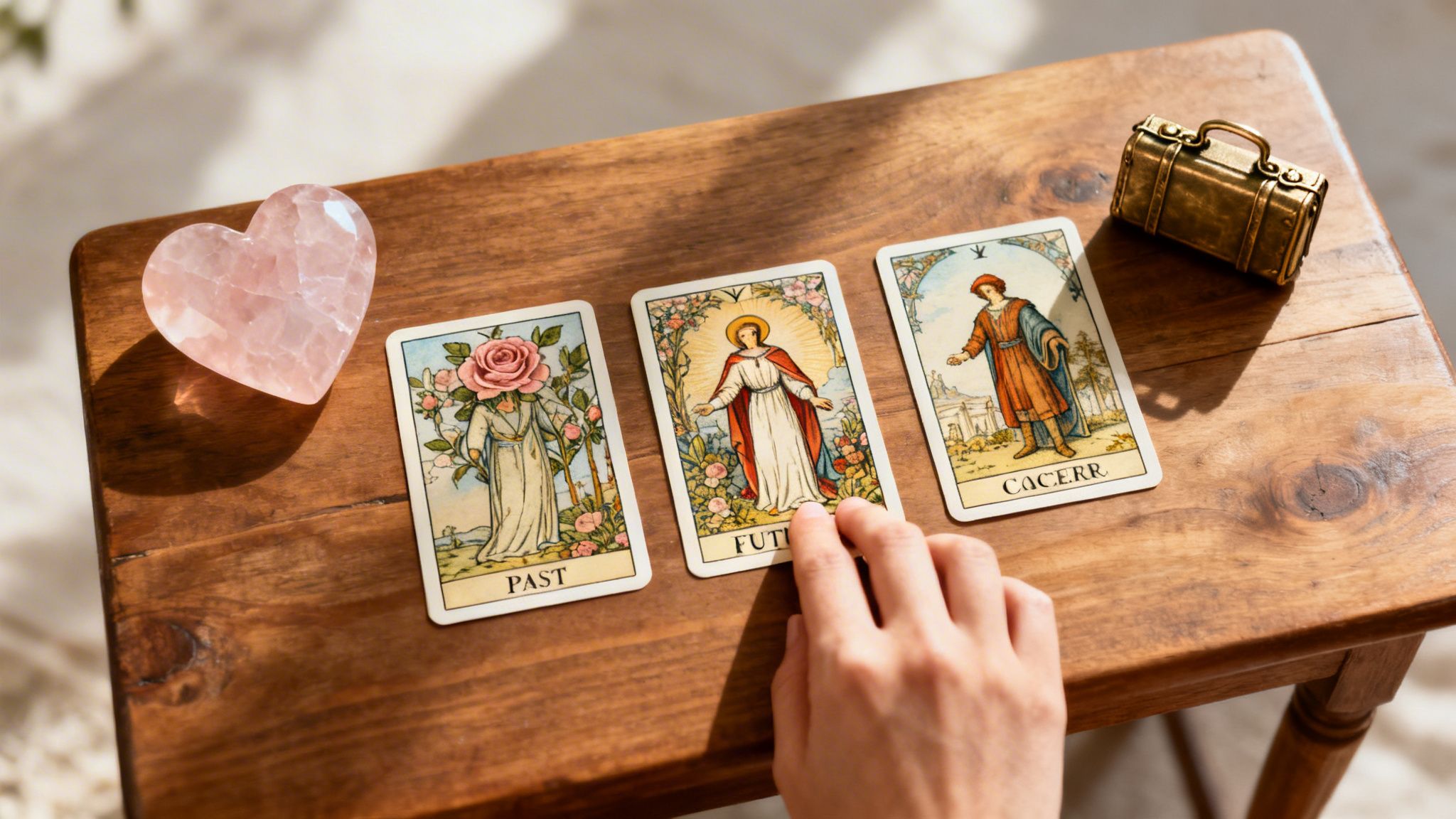
- Using Lotus Tarot for Deeper Relationship Clarity
- Making a Confident Decision The Path to Certainty
- Frequently Asked Questions About Relationship Doubts
That Lingering Question Is This Relationship Really Right
You wake up next to your partner and feel tension before the day even starts. Nothing dramatic happened. On paper, things still look fine. But your body is already telling the truth.
Take that seriously.
Relationship doubt does not always mean you should leave. It does mean you should stop brushing off your inner alarm. A lot of people stay in painful confusion because they keep trying to reason away a basic doubt. They call it stress, timing, fear of commitment, or being too sensitive. Sometimes that is true. Often, it is avoidance.
Good on paper is not the same as good for your soul
A relationship can meet the outer requirements and still miss the deeper mark.
Your partner may be loyal, attractive, successful, and kind to everyone else. If you feel unseen with them, chronically tense around them, or smaller in their presence, the relationship is not nourishing you. Chemistry cannot fix that. Shared history cannot fix that either.
Use both discernment and intuition here. Psychology helps you name patterns. Intuition helps you feel what those patterns are doing to your spirit. You need both. Head only will keep you rationalizing. Heart only will keep you attached to potential.
Ask yourself these questions and answer them without editing:
- After conflict: Do I feel more grounded, or more confused?
- When I share something tender: Do they respond with care, or control?
- In ordinary daily life: Do I feel relaxed, or on alert?
- When I picture a future together: Does my body open, or tighten?
Those answers matter. They reveal the lived truth of the relationship, not the sales pitch.
If you can only keep the connection by abandoning yourself, the connection is too expensive.
Stop evaluating promises. Evaluate patterns.
People get trapped by future-faking all the time. They stay because the relationship could become healthy, deep, stable, or mutual. That is fantasy unless there is real evidence.
Look at what repeats.
Does your partner repair after hurt, or dodge responsibility? Do hard conversations lead to understanding, or to blame, shutdown, and confusion? Do you keep having to lower your standards to keep the peace? Patterns answer the question that hope keeps dodging.
If your relationship keeps looping through the same unresolved pain, read this guide on 8 signs you need couples counseling. It can help you tell the difference between strain that can be repaired and a bond that keeps draining you.
The right relationship does not feel perfect. It feels honest. It gives you enough steadiness, mutual effort, and emotional safety that your life becomes clearer inside it, not harder to survive.
Your Relationship Compass The Four Pillars of a Healthy Partnership
A relationship feels confusing when you judge it by mood, chemistry, or potential. Judge it by structure instead.
I use four pillars. They tell you whether this bond can carry real life, not just romantic intensity. If one pillar is weak, you will feel friction. If two are weak, you will start paying for the relationship with your peace, energy, and self-respect. If three are weak, you are usually attached to hope.
As noted earlier, people consistently name trust, honesty, respect, communication, and friendship as the core ingredients of a strong partnership. That is not abstract. You can test each one in daily life.
Emotional safety
Emotional safety decides whether love becomes healing or harmful.
Ask a plain question. Can you bring your real feelings into the room without being punished for them? If the answer is no, stop calling the relationship healthy. Call it what it is. Unstable.
Emotional safety looks like this:
- You tell the truth without bracing for impact.
- Your difficult feelings are met with care, not mockery or control.
- After tension, someone reaches for repair instead of distance, silent punishment, or mind games.
Watch the small moments. They matter more than grand gestures. A contemptuous tone, a bored stare, a joke at your expense, a cold shutdown after you open up. Those behaviors train your nervous system to stay guarded. If that pattern is familiar, learn how to deal with relationship stress without abandoning your own center.
Shared growth
A healthy relationship creates movement.
You do not need identical goals or matching personalities. You need compatible growth. The bond should help both of you become more honest, more accountable, and more emotionally mature. If the relationship keeps both of you stuck in the same wounds, the connection is not deep. It is repetitive.
Use this table as a quick check:
| Question | Healthy answer |
|---|---|
| How do we respond to feedback? | We may react at first, then return and work through it |
| What happens around old wounds? | We protect each other’s healing instead of weaponizing pain |
| Are we building a better life? | The relationship adds direction, stability, and real follow-through |
Love alone does not guarantee growth. Plenty of people love each other and still block each other’s evolution.
Authentic self
The right relationship gives you more access to yourself, not less.
Compromise is part of intimacy. Self-erasure is not. If you keep shrinking your voice, style, ambition, sexuality, spiritual practice, humor, or standards just to stay chosen, your body already knows the truth. You are adapting to survive the bond, not relaxing inside it.
Here is the clean distinction:
- Healthy compromise: “We differ, so we created habits that respect both people.”
- Identity loss: “I stay quiet, go along, and call that maturity.”
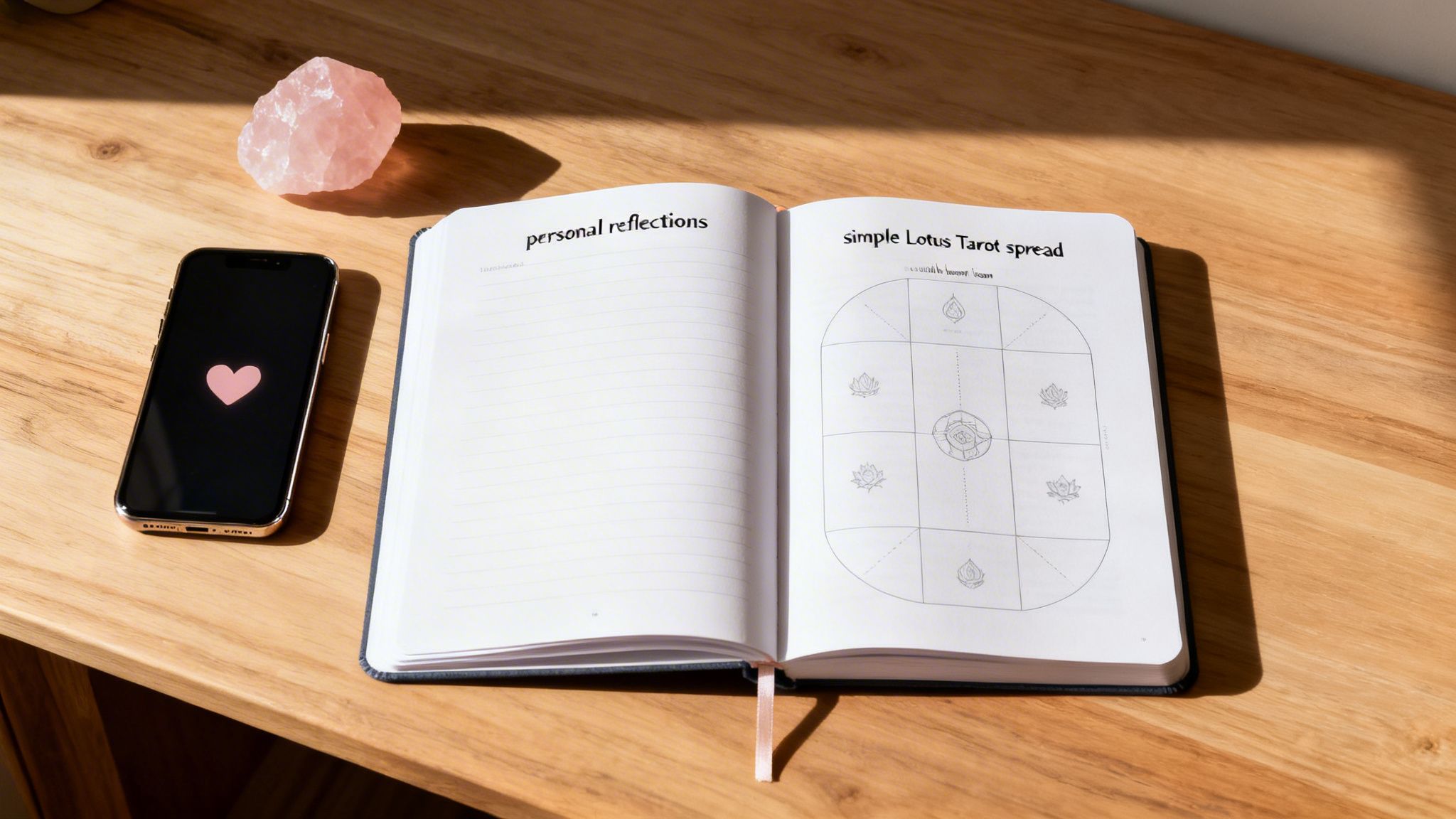
If you want a reflective tool for this pillar, use a 5 card relationship tarot spread after journaling. Psychology helps you name the pattern. Tarot helps you notice what your rational mind keeps minimizing.
The right partner will challenge your ego at times. They should not require you to disappear.
Mutual respect
Mutual respect is deeper than being nice.
Respect shows up in tone, timing, honesty, and restraint. It means neither person treats the other as inferior, embarrassing, hard to love, or in need of fixing. It also means admiration stays present, even during frustration.
Ask these questions and answer them without spin:
- How do they speak to you when upset? Respect does not vanish under pressure.
- What happens when you set a boundary? Respect accepts limits without revenge, guilt, or sulking.
- Do you admire their character, not just your chemistry? Attraction without respect burns hot and ends badly.
Here is a helpful visual reflection on healthy partnership dynamics:
These four pillars give you a grounded way to evaluate the relationship with both discernment and intuition. If they are present, love has something solid to stand on. If they are missing, chemistry will not save it.
Putting Your Connection to the Test Practical Stress Tests
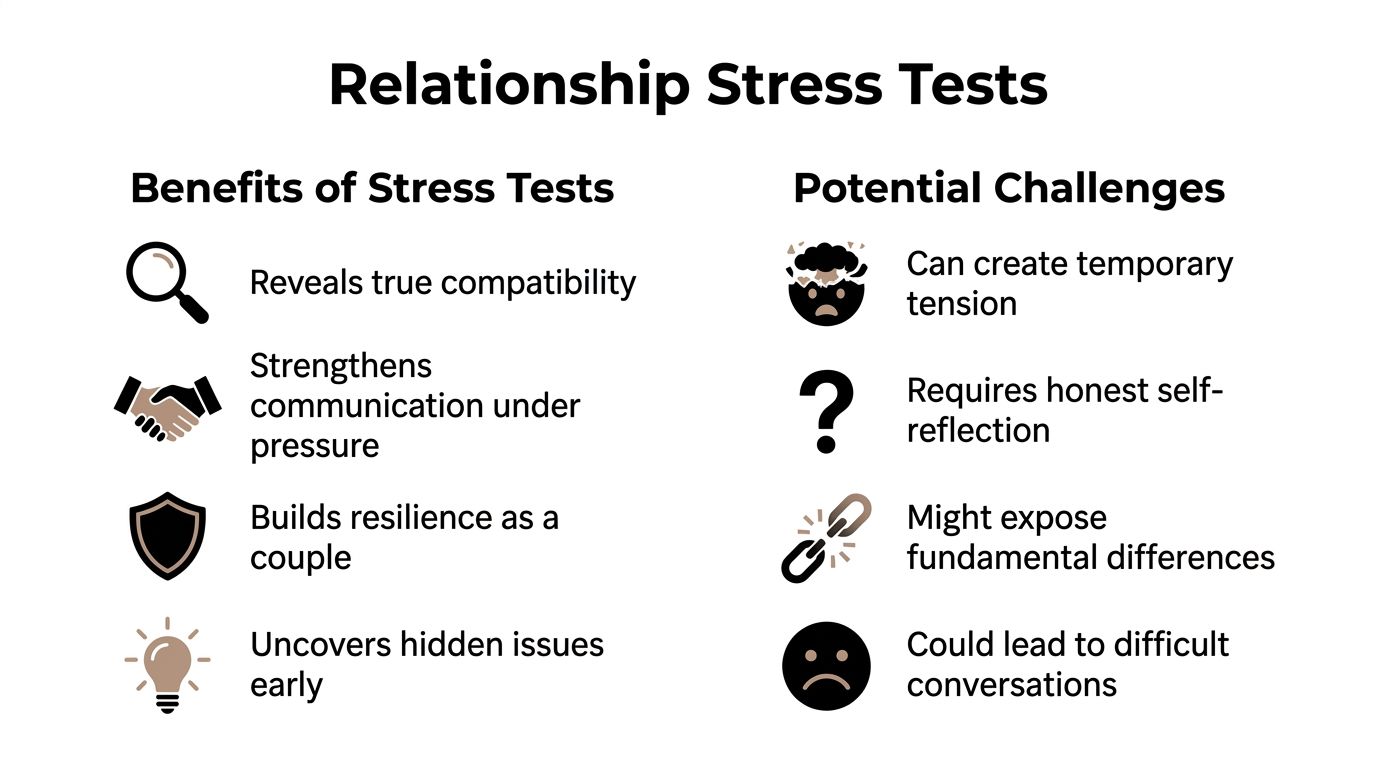
Anyone can look compatible on a calm Saturday afternoon. Real character appears under strain.
That is why I want you to stop evaluating your relationship only by big feelings. Watch what happens when one of you is tired, disappointed, jealous, stressed, busy, or scared. Those moments reveal the operating system of the relationship.
Research on John Gottman’s work reports that his approach can predict divorce with over 90% accuracy, and one key measure is the 5 to 1 positive-to-negative ratio during conflict in stable, happy couples (Farnam Street on Gottman’s Magic Ratio). That does not mean you need to count every sigh. It means the tone of your connection matters.
The conflict test
Pay attention to your last three disagreements.
Not the topic. The process.
Did one of you try to understand, or just win? Did the conversation stay on the issue, or turn into character assassination? Did repair happen afterward, or did you both pretend nothing happened while resentment hardened?
Use this quick check:
- Healthy conflict: You both stay on one issue, take breaks if needed, and return with some willingness to solve it.
- Unhealthy conflict: One person floods the room with blame, contempt, silence, threats, or emotional punishment.
- False peace: You avoid conflict entirely because honesty feels too expensive.
If relationship pressure is already spilling into sleep, work, or mood, this practical guide on how to deal with relationship stress can help you separate temporary overload from a chronic dynamic.
The bid for connection test
A bid for connection is a small reach. “Look at this.” “Can we talk?” “I had a hard day.” “Come sit with me.”
These moments seem small. They are not small. They tell you whether the relationship is emotionally responsive.
Watch for a week:
| Bid | Turning toward | Turning away |
|---|---|---|
| You share good news | They engage and celebrate with you | They barely react |
| You ask for comfort | They make room for you | They act annoyed |
| You invite quality time | They respond warmly | They delay, dismiss, or avoid |
If one or both of you keep missing these moments, distance grows fast.
The pressure test
Ask three grounded questions:
- What happens when one of us is stressed? Do we become a team, or do we become collateral damage to each other’s moods?
- What happens when one of us succeeds? Is there support, or subtle competition?
- What happens when one of us needs space? Is space respected, or treated like rejection?
A strong relationship is not one without stress. It is one where stress does not instantly destroy goodwill.
Red flags that deserve plain language
Some patterns do not need spiritual decoding. They need immediate honesty.
- Contempt: Mockery, disgust, belittling, cruel sarcasm.
- Stonewalling: Repeated shutdown that blocks repair.
- Chronic defensiveness: Nothing is ever owned.
- Fear-based communication: You are always calculating how to avoid a blowup.
- Reality distortion: Your clear experience keeps getting denied or rewritten.
If you want a reflective tool while you observe these patterns, a 5-card relationship spread tarot reading can help you organize what is happening beneath the surface.
Aligning Your Life Paths Beyond Just Love and Romance
Love is not separate from the rest of your life. It affects your work, your finances, your confidence, your health, and the size of the life you allow yourself to build.
A relationship can be tender and still be misaligned. Here, many people get trapped. They ask, “Do we love each other?” when they should also ask, “Can we build in the same direction?”
Long-term research often referred to as the two-year rule suggests that divorce rates are lower for couples who marry after dating for about two years, because that timeline gives people a better chance to move past infatuation and assess values and goals more clearly (Red magazine on the two-year rule).
Career matters more than people admit
Pay attention to what your partner does when your ambition becomes real.
It is easy for someone to say they support your career. A true test comes when your goals require time, boundaries, study, relocation, risk, visibility, or a season where you cannot center the relationship every minute.
Look for these signs:
- They celebrate your wins without making them about themselves
- They respect your focused time
- They do not mock your ambitions as unrealistic, selfish, or inconvenient
- They can tolerate your growth without trying to reduce you
A subtle blocker rarely says, “I do not want you to succeed.” They say things like, “You’ve changed,” every time you become stronger.
Talk about the life, not just the love
You do not need to interrogate each other. You do need adult conversations.
Try questions like these:
- What kind of daily life are we each trying to build?
- What does financial responsibility mean to you?
- How do you handle career stress?
- What would matter most if one of us got a major opportunity?
- What does partnership look like when one person is stretched?
These are not mood killers. They are clarity makers.
Shared direction beats vague chemistry
Chemistry can start a relationship. Shared direction sustains one.
If one person wants rooted stability and the other wants endless spontaneity, that matters. If one person values inner work and the other mocks introspection, that matters. If one person is building a demanding career and the other resents the discipline required, that matters.
You do not need identical dreams. You do need a life structure where both people can breathe.
Using Lotus Tarot for Deeper Relationship Clarity
Sometimes your mind already knows the issue, but your deeper self needs a symbol to bring it into focus. That is where tarot earns its place.
Used well, tarot does not replace judgment. It sharpens it. It helps you see what your fear, longing, or attachment has blurred. Interest in this kind of guidance is growing. One referenced trend notes a 42% increase in global searches for “soulmate tarot” in 2025, and internal data cited in the same source says 68% of users turn to tarot apps for relationship clarity (relationship intuition trend reference).
Ask better questions
Weak tarot questions create vague answers.
Do not ask only, “Are they the one?” Ask questions that reveal dynamics, timing, and responsibility.
Better prompts:
- What truth about this relationship am I resisting?
- What energy am I bringing into this bond?
- What lesson is this relationship trying to teach me?
- Is this connection supporting my highest good right now?
- What needs to change for this relationship to feel aligned?
If you want a focused place to begin, the love and relationship tarot reading is one way to explore emotional dynamics, choices, and compatibility questions through a structured spread.
A simple spread for relationship truth
Use a five-card layout with these positions:
| Card position | Meaning |
|---|---|
| Card 1 | What I feel consciously |
| Card 2 | What I feel underneath |
| Card 3 | What my partner or the connection is reflecting back to me |
| Card 4 | What strengthens this relationship |
| Card 5 | What truth I need to act on |
Do not rush to “positive” meanings. Read for honesty, not comfort.
Card combinations that matter in love readings
Single-card meanings are useful. Combinations tell the complete story.
The Lovers with The Devil
This combination often points to intense attraction mixed with attachment, temptation, or unhealthy bonding. The connection may feel fated, but it can also keep you stuck in cycles you already know are hurting you.
Ask yourself whether the bond is based on freedom or compulsion.
Two of Cups with The Tower
This is one of the clearest signs that a meaningful connection is being shaken awake. The bond may be real, but the structure around it cannot stay the same. Illusions break. Hidden truths surface. If the relationship survives, it usually has to rebuild on more honesty.
The Moon with Seven of Swords
Confusion plus concealment. This pairing often appears when you already sense something is off but cannot yet name it cleanly. It can point to mixed signals, self-deception, avoidance, or information being withheld.
Trust your discomfort. Then verify it in real life.
Ten of Pentacles with Three of Wands
This is a strong pairing for long-range potential. It suggests shared future-building, practical stability, and expansion. In plain language, this often shows two people who can dream and plan together without one person carrying all the maturity.
Four of Swords with Justice
Pause before deciding. This combination does not scream breakup or commitment. It says, “Get quiet. Get honest. Then choose with integrity.” It is excellent when emotions are loud and clarity is lagging.
When career and relationship questions overlap
Many readers come to tarot because love and career are tangled together.
If you pull The Emperor beside Queen of Wands, I read that as a serious question about power and autonomy. It can suggest a clash between personal ambition and a partner’s need for order or control. It can also describe a couple who can build something substantial if both respect leadership in different forms.
If you pull Three of Pentacles with King of Cups, that often shows a partner who can collaborate emotionally and practically. It is a green light for asking, “Can we handle real-world pressure together?”
If you pull Eight of Pentacles with Five of Cups, one person may be pouring energy into work or self-improvement while the relationship is carrying grief, disappointment, or emotional neglect. That is not a verdict. It is a call to rebalance.
Tarot is most useful when it confirms a pattern you can also see in daily life. Symbol first, action second.
Read the energy, then take action
After a reading, do one grounded thing.
If the cards show confusion, ask a direct question. If they show imbalance, name the imbalance. If they show fear of loss, stop bargaining with yourself and look at the relationship as it exists. Tarot should move you toward truth, not keep you suspended in magical thinking.
Making a Confident Decision The Path to Certainty
At some point, reflection has to become decision.
If you stay in endless analysis, you train yourself to distrust your own knowing. That is why I recommend a defined period of observation. Choose a window. Watch the relationship clearly. Tell the truth at the end of it.
A machine-learning study of more than 11,000 couples found that your perception of your partner’s commitment is one of the strongest predictors of satisfaction, and that this perception outperformed individual traits like age or personality by 2 to 3 times (University of Minnesota on relationship satisfaction predictors).
That matters because many people keep trying to reason away a basic doubt. “Do they really choose me?” If your answer keeps landing on no, listen.
Use a decision timeline
Pick a period of conscious observation. Not forever. Not “we’ll see.”
During that window, track a few things in writing:
- Commitment: Do their actions match their words?
- Safety: Can you tell the truth without chaos?
- Effort: Are both people working, or only one?
- Future: Does this relationship feel more aligned over time, or more draining?
You are not waiting for perfection. You are looking for direction.
Let your body weigh in
Your nervous system notices what your mind excuses.
Sit still and ask, “What happens in me when I imagine staying?” Then ask, “What happens in me when I imagine leaving?” Notice your breath, chest, jaw, stomach, and shoulders.
This is not about choosing the option with zero fear. Every real decision carries fear. It is about distinguishing grief from misalignment. Sometimes staying feels familiar but heavy. Sometimes leaving feels sad but clean.
If you need one final question
Ask this and answer without bargaining:
“Does this relationship, as it is now, honor who I am and support the life I want?”
If your answer is yes, recommit with your whole heart and clear requests. If your answer is no, stop asking the relationship to become something it has not shown you.
If you want a direct symbolic mirror for that final moment, a yes or no oracle tarot reading can help you cut through mental noise before you make your call.
Frequently Asked Questions About Relationship Doubts
| Question | Answer |
|---|---|
| Is it normal to doubt a good relationship? | Yes. Doubt can come from fear, old wounds, or real incompatibility. The point is not to eliminate doubt instantly. The point is to investigate it with honesty. |
| What if I love them but feel off anyway? | Love is not the only requirement. You can love someone and still feel unsafe, unseen, or misaligned. Take the “off” feeling seriously. |
| Should I stay if nothing is terribly wrong? | “Not terrible” is not the same as right. If the relationship repeatedly weakens your peace or identity, that is enough reason to evaluate it thoroughly. |
| Can tarot tell me whether to leave? | Tarot can reveal patterns, motives, fears, and hidden truths. It should support discernment, not replace your agency. |
| What if my intuition and logic disagree? | Slow down and gather more evidence. Usually one of them is carrying fear, and the other is carrying truth. Time, observation, and honest conversation help separate them. |
| How long should I wait for clarity? | Long enough to observe patterns clearly, not so long that limbo becomes your lifestyle. Set a private timeline and honor it. |
| What if my partner says I am overthinking? | That may be true, or it may be a way of dismissing your concerns. A healthy partner helps create clarity. They do not punish you for seeking it. |
| Can a relationship be right even if it is hard? | Yes. Hard seasons happen. The key question is whether the hardship deepens teamwork and honesty, or whether it exposes chronic disrespect and instability. |
If you want a quiet, personal way to reflect on your love life, career crossroads, or one pressing yes-or-no question, Lotus Tarot Reading offers free spreads you can use on demand. Choose a simple draw when you need a fast answer, or a deeper spread when you want to explore the pattern beneath the question.