You’re probably here because a question won’t leave you alone.
Maybe you keep checking your phone, wondering if your ex will text. Maybe you’re staring at a job listing and asking yourself whether to apply, stay put, or finally leave the role that drains you. In that kind of moment, typing are online tarot readings accurate into a search bar makes sense. You’re not just looking for prediction. You’re looking for relief, clarity, and something solid enough to help you take the next step.
Tarot can help with that. But it helps most when you ask a better question than “Will this definitely happen?” A more useful question is, “What is this reading showing me about my situation, my patterns, and my options?”
The Search for Answers in a Digital World
It often starts late at night.
You’ve replayed the conversation. You’ve read the email twice. You’ve asked friends for advice, but their answers only go so far because they aren’t living inside your heart or your career crossroads.

That’s when online tarot becomes appealing. It’s private. It’s immediate. It gives shape to feelings that have been swirling around without language.
Many people seek something beyond supernatural proof. What they often need is this:
- Love clarity: Is this relationship growing, stalled, or teaching me something I don’t want to face?
- Career direction: Am I meant to stay, pivot, ask for more, or start over?
- Emotional grounding: What am I missing because fear, hope, or confusion is too loud?
Tarot is most helpful when you stop treating it like a courtroom verdict and start treating it like a conversation. The cards don’t have to act like a fixed script of the future to be accurate in a meaningful way. They can reflect what’s active in your inner world right now.
Sometimes a reading feels accurate not because it predicts every detail, but because it names what you already sensed and didn’t yet trust.
That matters in love and career especially. Those are the areas where people often want certainty, but what they usually need first is perspective.
A good online reading can slow your mind down. It can show tension, possibility, timing, resistance, desire, and the role you are playing in the pattern. That’s not a small thing. It can be the difference between chasing reassurance and making a thoughtful choice.
How Online Tarot Readings Work
Some readers imagine there must be a big difference between pulling cards in person and pulling them online. In practice, online readings usually fall into two forms, and each works a little differently.
Automated readings
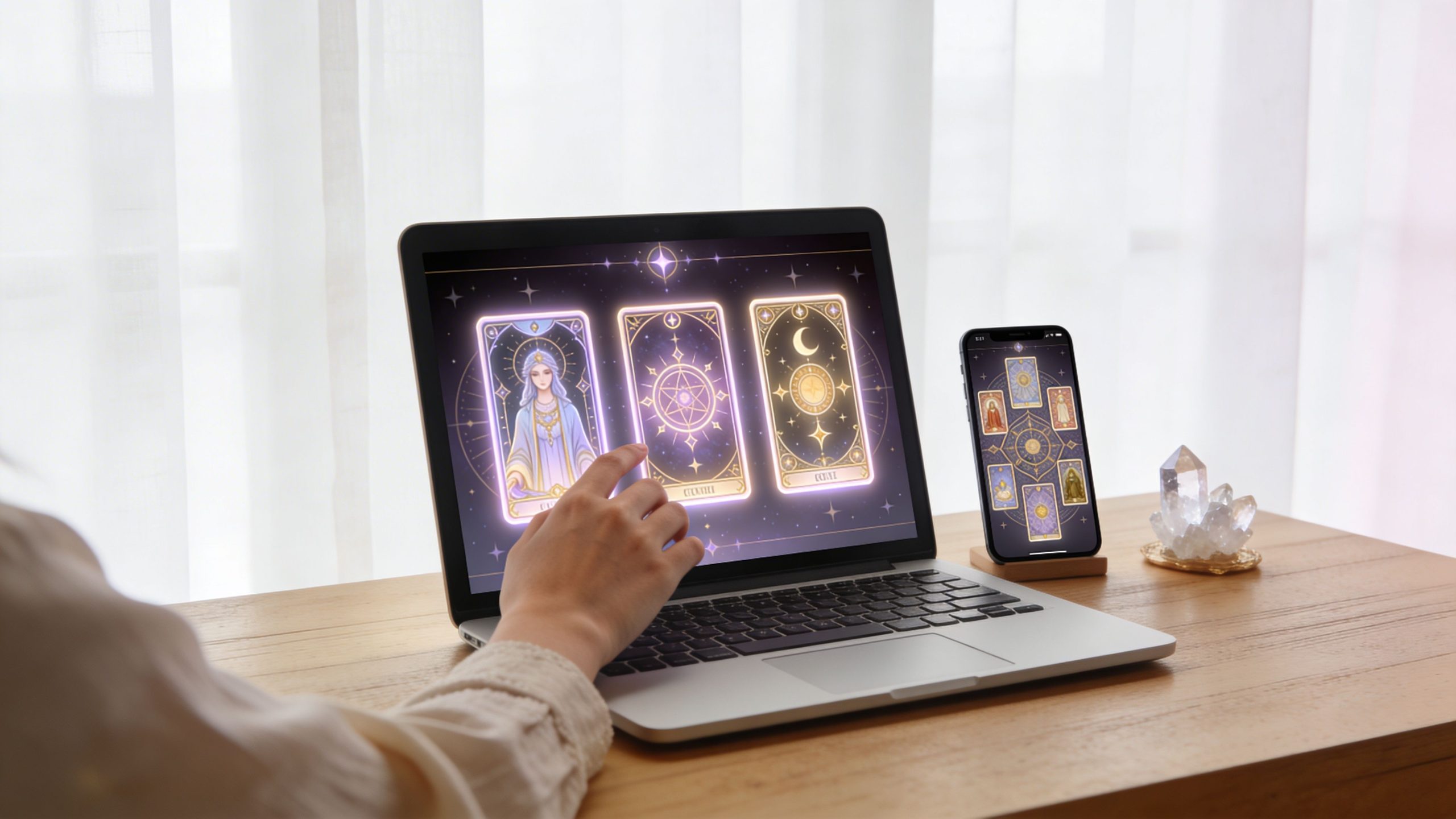
An automated reading uses a digital system to select cards and pair them with interpretations. The selection process often functions like a randomized shuffle. You focus on your question, choose a spread, and reveal the cards.
That can sound impersonal at first. But many people experience it as a kind of digital mirror. The cards don’t need to know your biography to spark recognition. They present symbols. You bring the living context.
If you want to try a simple version, a one card tarot reading works well for focused questions like “What energy am I bringing into this relationship?” or “What do I need to understand about my work life today?”
Live readings
A live online reading happens through chat, phone, or video with a real reader. In that format, the cards are only part of the experience. The reader listens, asks follow-up questions, notices nuance, and helps you connect one card to another.
That can be useful when your question has layers.
For example, “Will I get back together with him?” may contain several different questions:
- Do I still want this relationship, or do I want closure?
- Is there mutual effort, or only longing?
- What pattern would repeat if we reconnected?
- What would healing look like if reunion never came?
A live reader can help untangle those threads in real time.
What the cards are doing
Tarot works best when you think of it as structured reflection.
The structure matters. A spread creates positions. Each card adds a symbol, a tension, or a possible direction. Your mind responds to that structure by making connections. That’s why even one card can feel striking. It gives your intuition something specific to work with.
Practical rule: The clearer your question, the clearer the reading. “What should I understand about this job offer?” will usually help more than “Tell me my future.”
Why intention still matters online
Whether the cards are selected by software or by a human hand, your attention changes the experience. When you pause, focus, and ask with honesty, you’re less likely to chase fantasy and more likely to notice truth.
That’s why online tarot can still feel intimate. The screen changes the format, not the need behind the question.
The Psychology of a Spot-On Reading
You open an online reading late at night, asking about an ex or a job decision. Three cards appear. Within seconds, something in the message feels uncannily personal, almost as if the reading reached into a private part of your life.
That reaction makes sense. A reading can feel accurate for spiritual reasons, psychological reasons, or a mix of both. If your goal is usefulness, the better question is not “Was this magically exact?” It is “Why did this land so strongly, and what can I learn from it?”
One well-known explanation is the Barnum effect, also called the Forer effect. Psychologists use this term for statements that are broad enough to fit many people, yet still feel highly specific to the person hearing them. A 2023 analysis discussed by psychologist Charles Morgan revisits this idea and why people often experience generalized insights as highly personal (analysis reference).
The Barnum effect in plain language
A tarot message can work like a mirror in soft lighting. You do see yourself in it, but the edges are gentle enough that many people could recognize themselves there too.
Statements such as “you are healing from disappointment,” “you want love but fear being vulnerable,” or “part of you is ready for change, but another part resists it” can resonate with a wide range of readers. Love and career readings are especially likely to do this because relationships and work already carry hope, fear, and uncertainty.
That does not make the reading empty. It shows that tarot often works through recognition. The card gives your mind a shape, and your experience fills in the details.
Confirmation bias shapes what feels accurate
A second process matters too. Your attention naturally clings to the parts that fit and slides past the parts that do not.
This is significant because a reading is rarely remembered as a full transcript. It is remembered as a feeling and a few memorable lines. As noted earlier in the same analysis, high user satisfaction can reflect resonance and selective memory as much as literal prediction.
Here is a simple example. If a love reading suggests unfinished communication and your former partner texts two days later, that card may feel prophetic. If the same reading also mentioned patience, boundaries, or emotional confusion and those parts did not connect for you, they may fade into the background.
The same thing happens in career readings. Pulling the Eight of Pentacles, Two of Wands, and The Moon might stir a strong response if you are already restless in your role. You may focus on “new direction” and barely register the warning about uncertainty. The reading felt accurate, but part of that accuracy came from where your attention went.
Why this makes tarot more useful, not less
Psychology does not reduce tarot. It explains part of how tarot reaches people.
Symbols give the mind something to work with, much like dreams, poems, or journal prompts do. A card combination can surface feelings you have not said aloud yet. In that sense, a spot-on reading often reveals less about fixed fate and more about your inner patterning, what you fear, what you hope for, and what choice is asking to be made.
That is especially helpful for love and career questions, because those are the areas where people often confuse prediction with clarity. Tarot may not hand you a guaranteed outcome. It can show you the emotional weather around the situation, the habits affecting your choices, and the tension between what you want and what you are willing to do.
How to read the accuracy for yourself
Instead of asking whether every line is objectively true, test the reading in layers:
- What matches my current situation clearly
- What feels flattering or comforting, but vague
- What stings because it may be touching a real pattern
- What action or conversation does this suggest
- What changes if I read these cards as guidance instead of destiny
That last question is often the turning point.
If you pull The Lovers with Seven of Cups in a romance reading, usefulness may come from noticing a conflict between desire and fantasy. If you pull Eight of Pentacles with Judgment in a career spread, usefulness may come from recognizing that skill alone is not the issue. You may be ready for a bigger decision about direction, purpose, or self-trust.
A strong reading does not need to prove the future to have value. It only needs to bring honest insight close enough that you can work with it.
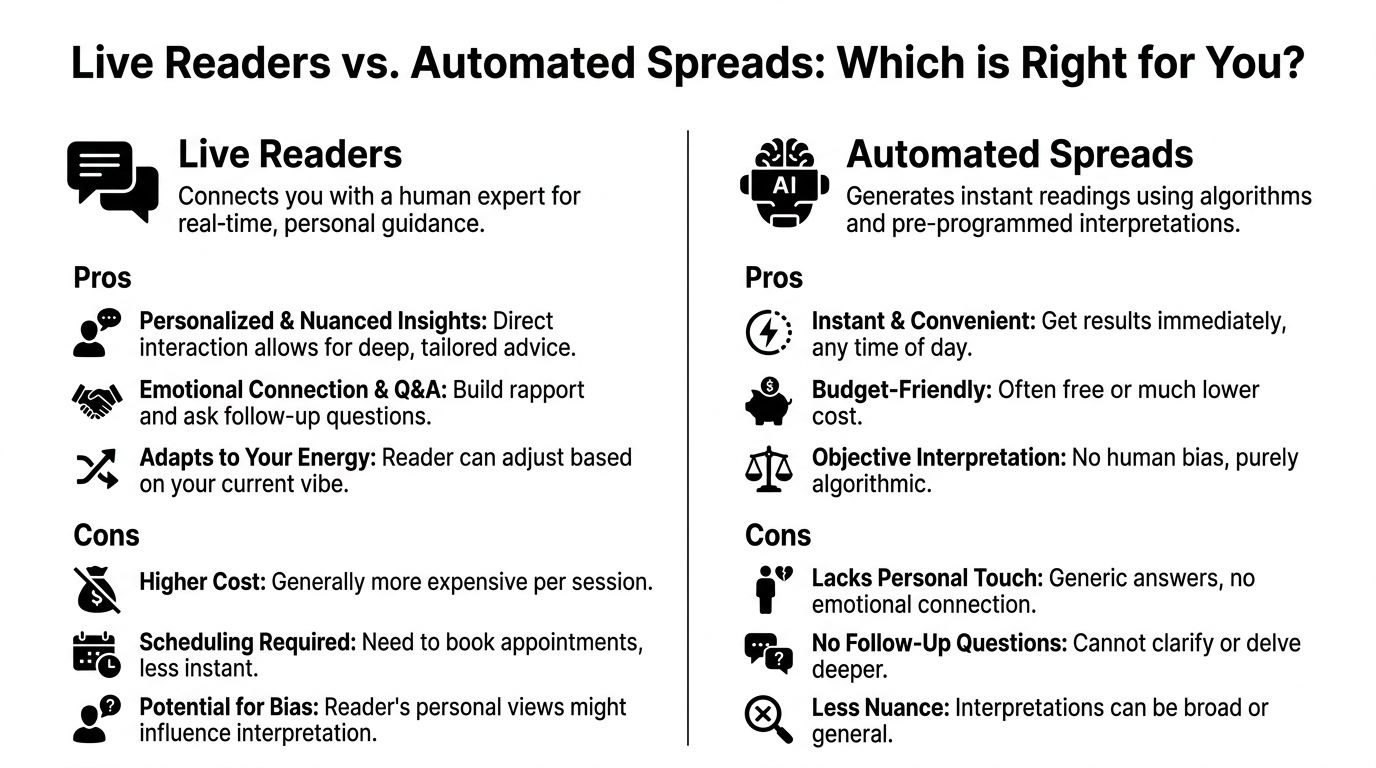
Live Readers vs Automated Spreads Which Is Better
There isn’t one winner for everyone. The better option depends on what kind of answer you need.
When a live reader helps more
A live reader is often better for emotionally layered questions.
If you’re asking about a complicated relationship, grief after a breakup, a triangle situation, burnout, or a career shift with financial pressure, conversation matters. A reader can notice contradictions in your wording, ask clarifying questions, and help separate fear from intuition.
Live sessions can also help when card combinations are complex. For example, if you pull The Moon, Seven of Cups, and Two of Swords, a reader can help you sort confusion, fantasy, and indecision rather than leaving you alone with abstract meanings.
When an automated spread is enough
Automated readings work well for quick check-ins.
They’re useful when you want a simple prompt for the day, a single lens on a love dynamic, or a low-pressure space to practice interpretation. Beginners often start here because it feels approachable.
Questions that fit this format include:
- Today’s focus: What energy should I work with today?
- Short love check-in: What am I not seeing in this connection?
- Career snapshot: What attitude will help me in my job search?
A noted concern is that automated pick-a-card style tools can invite projection without guidance. That issue is especially relevant because a source discussing this gap says 70% of users on free apps primarily seek quick Yes/No answers (tarotwithgord discussion).
A simple decision guide
| If your question is… | Better fit |
|---|---|
| Brief and focused | Automated spread |
| Emotionally tangled | Live reader |
| Mainly for self-reflection | Automated spread |
| Needing follow-up questions | Live reader |
| A beginner practice session | Automated spread |
| About a major decision with many moving parts | Live reader |
The core difference
The difference isn’t “real” versus “fake.”
It’s guided interpretation versus self-interpretation.
Automated spreads ask you to do more meaning-making yourself. That can be powerful if you’re reflective and honest. It can also lead you toward wishful thinking if you only look for what comforts you.
Live readers can add depth, but they aren’t automatically more truthful. A human reader may bring insight. A human reader may also bring bias.
Choose the format that matches the weight of your question, not just the urgency of your feelings.
If you want a quick Yes/No about texting your ex, an automated spread may be enough to help you pause and think. If you’re deciding whether to leave a long relationship or resign from a stable job, a more layered reading usually serves you better.
Getting Clear Answers for Love Career and Life
Most disappointment with tarot starts before the cards are even pulled. It starts with the question.
If you ask, “Will he come back?” you may get a dramatic reading but not a useful one. If you ask, “What is the current energy between us, and what would reconciliation require from both sides?” you open the door to a real answer.

If your question is centered on romance, a love and relationship tarot reading can help frame the issue around feelings, patterns, and likely dynamics rather than forcing a simple prediction.
Ask questions that create insight
Try shifting from fixed outcomes to revealing questions.
For love:
- Instead of: Will we get back together?
- Ask: What is the lesson of this connection, and what would need to change for reunion to be healthy?
For career:
- Instead of: Will I get the job?
- Ask: What strengths support this opportunity, and what obstacle should I prepare for?
For life direction:
- Instead of: Am I on the right path?
- Ask: What am I being asked to develop in this season?
These questions produce richer readings because they invite nuance.
Read combinations, not isolated cards
A single card rarely tells the whole story. Tarot becomes more accurate and more useful when you interpret relationships between cards.
Love combinations that confuse people
The Tower with Ace of Cups
This pairing often alarms people. They see The Tower and think disaster. In love, it can mean a false structure is breaking so a more honest emotional beginning becomes possible.
That doesn’t always mean reunion. It may mean a painful truth clears the path for genuine connection, whether with the same person or someone new.
The Lovers with Seven of Swords
This doesn’t always mean cheating, though it can point to secrecy or avoidance. More broadly, it can show a relationship where desire is present but honesty is weak. Someone may be withholding intentions, feelings, or key information.
Ten of Cups with The Tower
This combination can indicate that the image of happiness is being challenged. A family dream, future plan, or idealized relationship may not be as stable as it appears. The message isn’t “all is lost.” It’s “build on truth, not fantasy.”
Career combinations that deserve a closer look
The Emperor with Page of Pentacles
This is a strong combination for building something solid. The Emperor brings structure, leadership, and discipline. The Page of Pentacles brings study, a new role, or a practical opportunity. Together, they often point to learning within a stable system, or turning ambition into a serious plan.
Eight of Pentacles with Two of Wands
You may be ready to grow beyond skill-building into expansion. This pairing often appears when someone has done the work and now needs to think bigger. Apply. Pitch. Ask for responsibility. Stop hiding in preparation mode.
The Moon with Three of Pentacles
At work, this can suggest uncertainty inside a team setting. Communication may be unclear. Expectations may be implied rather than stated. Before making a major move, ask direct questions.
A simple method for interpreting combinations
Use this three-step approach:
Name each card plainly
What does each card say on its own?Look for tension or reinforcement
Do the cards support each other, soften each other, or challenge each other?Translate into a real-world message
What behavior, conversation, or decision does this point toward?
Here’s a quick example:
- Card one: The Hermit
- Card two: Knight of Cups
- Message: A romantic offer may be present, but you need reflection before responding. Don’t say yes just because attention feels good.
A visual walkthrough can help if you learn best by watching:
Questions to ask after every reading
Don’t stop at “That resonates.” Go one step further.
- What truth am I resisting here
- What action would honor this reading without becoming dependent on it
- What if this reading is describing my pattern, not my destiny
A strong reading doesn’t trap you in fate. It returns choice to your hands.
That’s where love readings become mature. That’s where career readings become practical. The cards can show energy, but you still decide how to answer it.
What Skeptics Say and Why It Matters
Skeptics make an important point. Tarot performs poorly when you treat it like a system for precise, testable forecasting.
A 2014 FiveThirtyEight analysis found that verifiable tarot forecasts had under 30% accuracy when checked against quantifiable baselines months later (FiveThirtyEight tarot analysis).
That matters because people ask tarot questions that sound simple but carry huge emotional weight. “Will I marry him?” “Will my boss fire me?” “Will this exact month change everything?” If you expect hard prediction, you’re likely to feel disappointed, misled, or dependent.
Where skeptics are right
Tarot is not a substitute for evidence, planning, or mental health support.
If a reading leaves you more panicked than clear, pause. If relationship anxiety or uncertainty spirals after readings, grounding tools like these Anxiety learning resources can help you return to your own center before seeking more answers.
Tarot also shouldn’t replace practical judgment. For major choices, it helps to keep spiritual guidance and reality-testing together.
Why the critique doesn’t end the conversation
The skeptical view is strongest when tarot is sold as certainty.
It is weaker when tarot is used as reflection. A spread can still be valuable if it helps you notice avoidance, name a desire, or prepare for a difficult talk. That kind of usefulness doesn’t depend on predicting exact events.
That’s also why clear expectations matter. A good boundary is to remember that tarot offers perspective, not guarantees. The page on this tarot reading disclaimer reflects that mindset well.
If a reading helps you think more clearly, act with more honesty, or understand your emotions better, it has done real work even if it didn’t predict the future with precision.
Turning Digital Cards into Personal Wisdom
Late at night, someone pulls a three-card spread on their phone after a tense text from a partner or a confusing meeting with a manager. The cards do not hand down a verdict. They work more like a mirror with symbols, reflecting fears, hopes, and patterns that are already present but hard to name in the moment.
That is the most useful way to judge online tarot.
If accuracy means exact prediction, online tarot has clear limits. The European Business Review discussion notes doubts about predictive claims, including some discussions reporting a 40% user drop-off after the first free reading. This distinction is important because prediction is only one way people measure a reading, and often not the one that creates the most value.
A stronger question is, “Did this reading help me see my situation more clearly?”
For love questions, that might mean noticing the difference between intuition and anxiety. A card like the Moon beside the Two of Cups can point to emotional uncertainty inside a real connection. For career questions, the Eight of Pentacles with the Two of Wands may highlight a choice between improving your current path and preparing for a new one. The cards are useful here because they turn a vague feeling into a clearer conversation with yourself.
Psychology helps explain why this can feel surprisingly accurate. Symbolic images give your mind something to respond to, much like a journal prompt that reaches a deeper answer than a yes or no question. You are not just receiving meaning. You are participating in it, selecting what fits, questioning what does not, and connecting the cards to real events in your life.
That active role matters.
Online tarot becomes personal wisdom when you slow down after the reading and ask three grounded questions: What emotion did this spread bring up first? What pattern does it remind me of in love, work, or decision-making? What small action would make this insight useful today? A reading that leads to an honest conversation, a clearer boundary, or a more thoughtful career move has done real work.
If you want a simple place to explore your own questions, Lotus Tarot Reading offers free on-demand spreads for love, career, Yes/No questions, and deeper multi-card readings so you can reflect at your own pace and apply the insights in a grounded way.