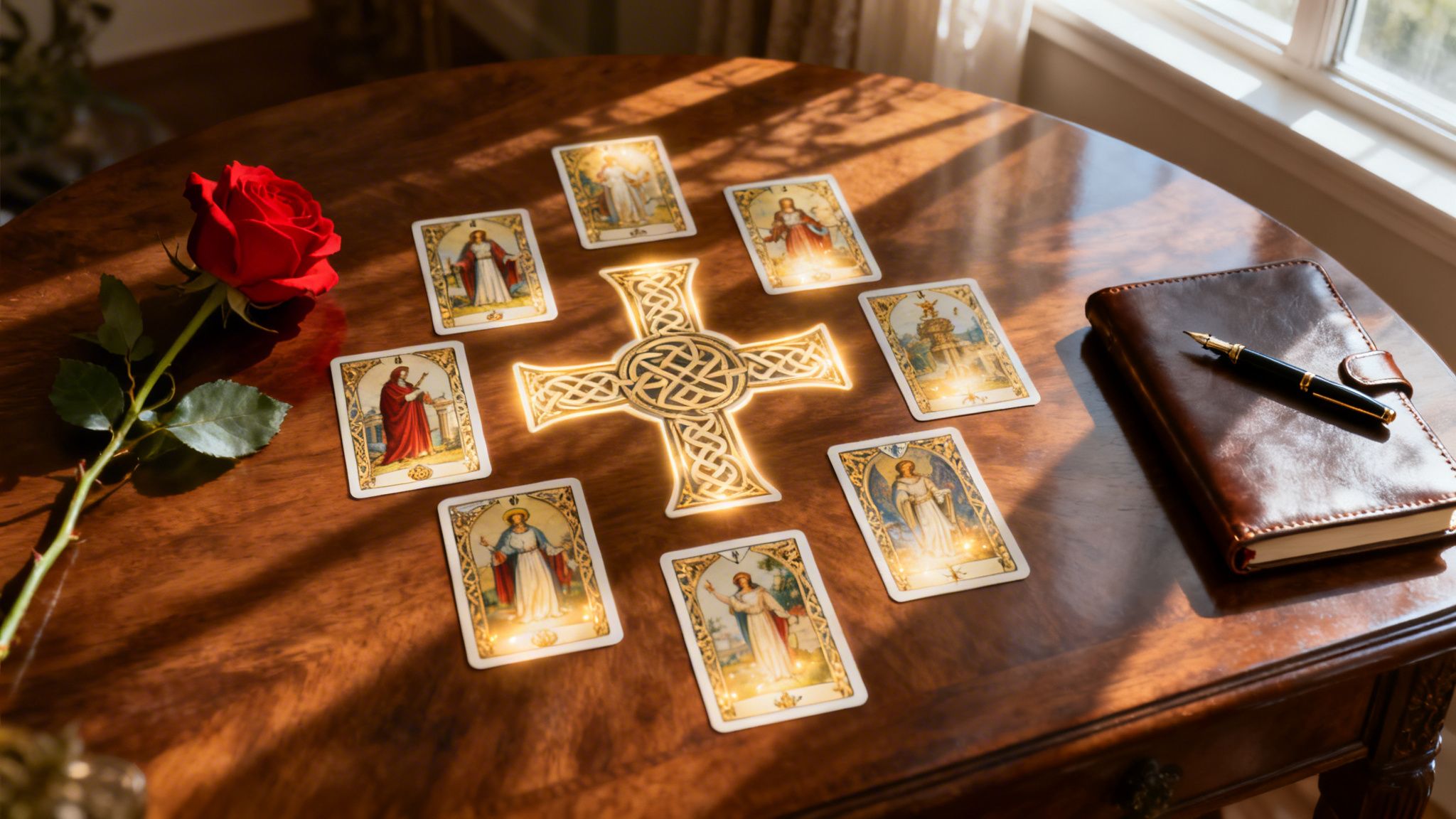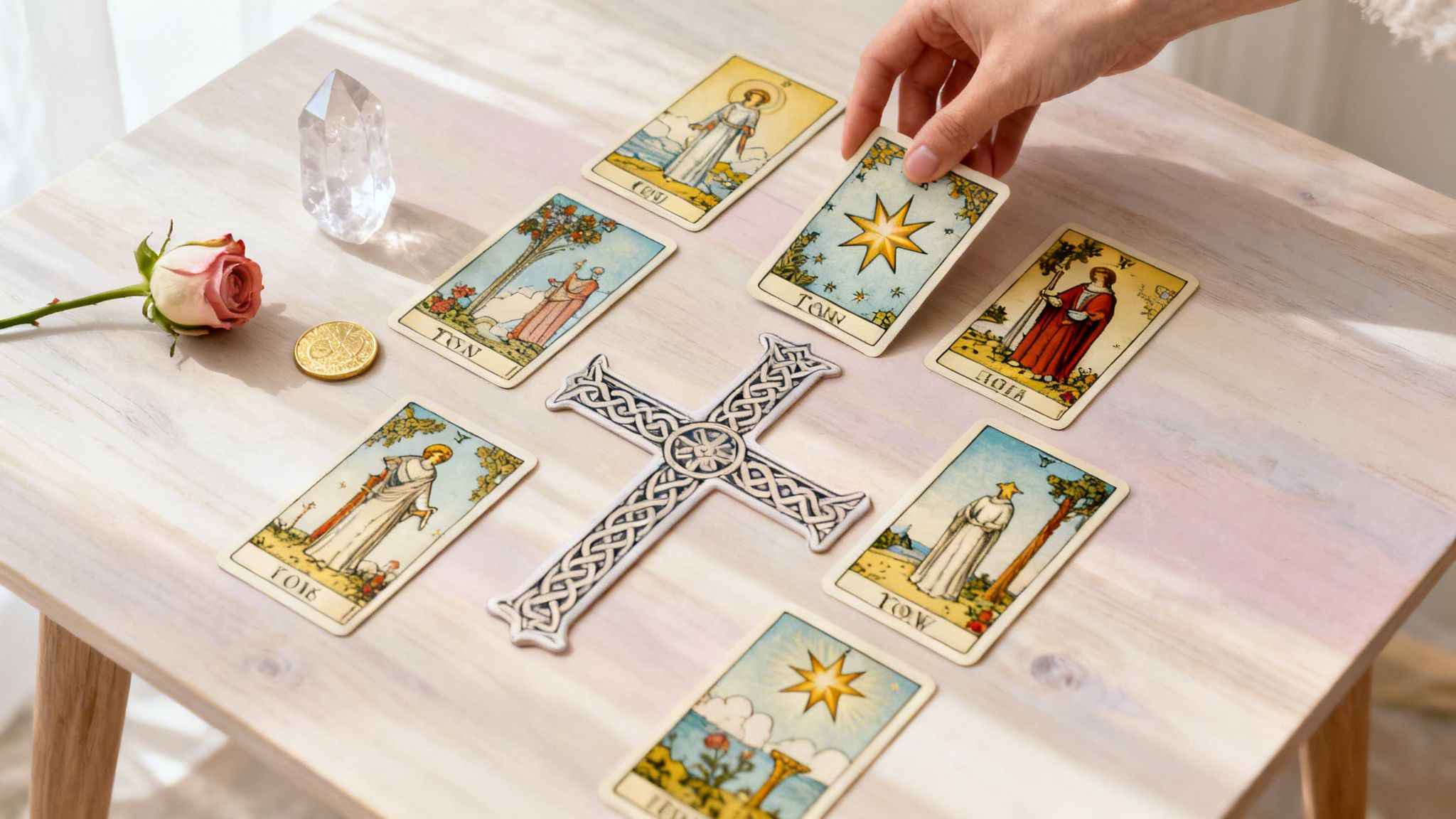
The journey to self-awareness doesn't start with some grand, earth-shattering epiphany. It begins with the quiet, daily practice of paying attention—noticing your thoughts and feelings without judgment, almost like you’re watching a movie.
This simple act of observation is what peels back the layers, revealing the hidden drivers behind your choices. It helps you finally understand why you react the way you do, especially when it comes to the big questions in love and your career.
- What Self Awareness Really Means and How Tarot Can Help
- Building Emotional Fitness with a Daily Tarot Practice
- Decoding Your Path in Love and Relationships
- Navigating Your Career with Confidence and Insight
- Using Digital Tarot for Mindful Reflection
- Creating Your Long-Term Self-Awareness Toolkit
- Frequently Asked Questions About Tarot for Self Awareness
What Self Awareness Really Means and How Tarot Can Help
True self-awareness isn't just knowing you’re happy or stressed; it's getting to the root of why. It’s the difference between knowing your own values (internal self-awareness) and understanding how others perceive you (external self-awareness). Mastering this skill is the secret to building a life that actually feels like yours.
But how do you start? Instead of getting lost in your own head, you can open up a direct line of communication with your inner self. The tarot, with its rich language of symbols and archetypes, is the perfect tool for the job.
An Emotional Check-In to Start Your Journey
Before you even pull a card, you can build your self-awareness muscle with a simple, three-step emotional check-in. Try to do this every day.
- Notice: Ask yourself, "What emotion am I feeling right now?" Get specific. Is it a vague sadness, or is it disappointment? Is it anxiety, or is it anticipation?
- Locate: Pinpoint where this emotion lives in your body. Is there a tightness in your chest? A fluttering in your stomach? A heaviness in your shoulders?
- Question: What thought or event just triggered this feeling? Don't judge it or try to fix it. Just identify it.
This practice primes you to use the tarot as a mirror. When you draw a card, you’re not looking for a fortune teller's prediction. You’re asking an archetype to give a voice to the very feelings you just uncovered.
Tarot provides a visual vocabulary for our inner world. When you’re struggling to find the words for a gut feeling, a card like The Hermit or the Queen of Cups can give it a name and a face, making it easier to understand.
This approach flips the script on tarot, turning it from a parlor game into a profound dialogue with your subconscious. It’s how you get real answers to what you're truly searching for.
Connecting Feelings to Tarot Archetypes
To get you started right away, here’s a quick guide to how common feelings from your check-in might connect to specific tarot archetypes. Think of this as a jumping-off point for your readings.
| If You're Feeling… | A Potential Tarot Archetype to Explore… | What It Might Mean for You… |
|---|---|---|
| Stuck or Uninspired | The Hanged Man | A call to pause and see your situation from a completely new angle. |
| Anxious About the Future | The Moon | A sign to explore your hidden fears and learn to trust your intuition. |
| Confident and in Control | The Emperor | An affirmation of your power to create structure, order, and boundaries. |
| Heartbroken or Sad | The Three of Swords | An acknowledgment of a painful truth, which is the first step toward healing. |
Building Emotional Fitness with a Daily Tarot Practice
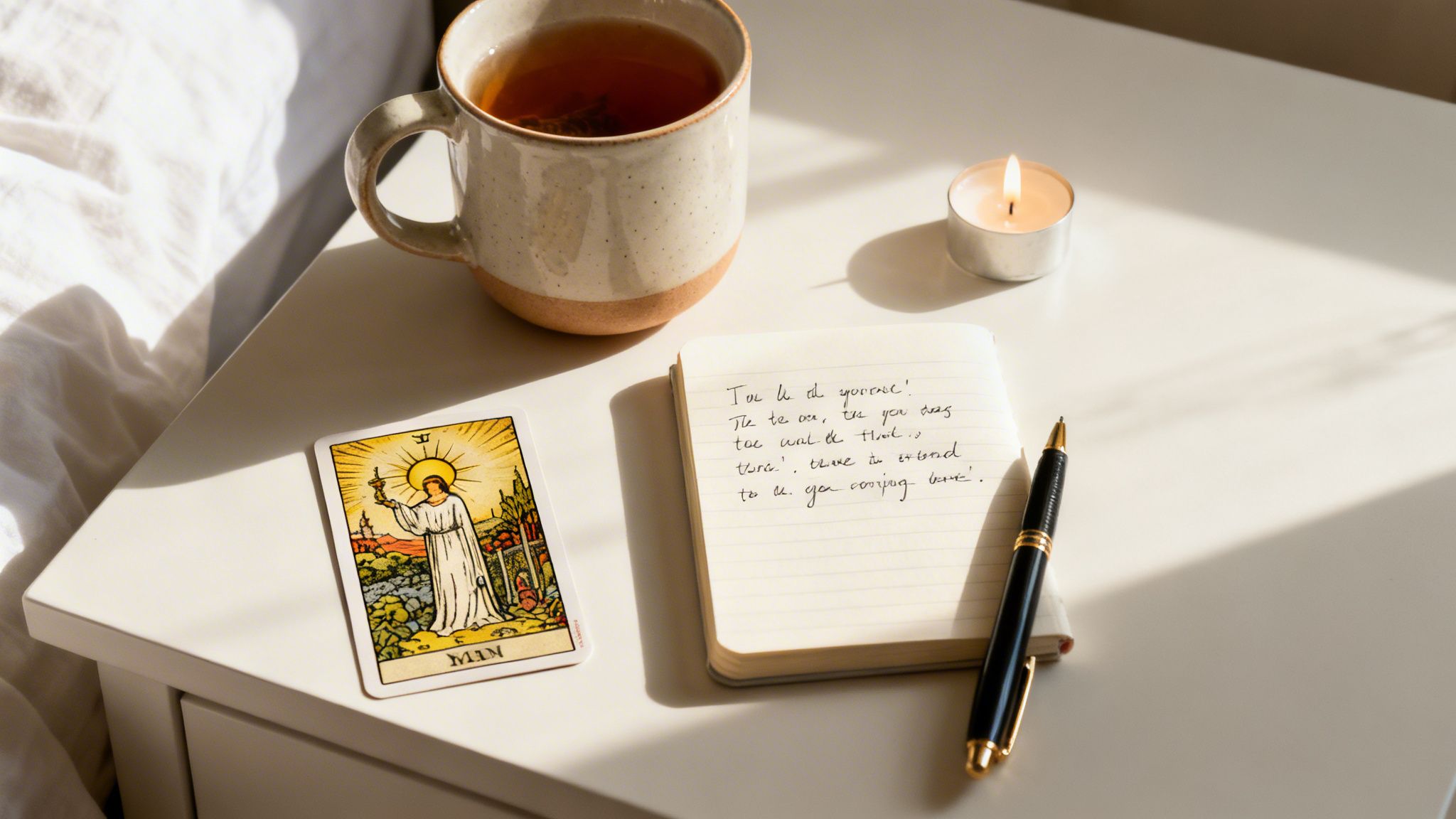
What if you had a direct line to your subconscious, a way to check in with your deepest self before the day's noise takes over? That’s exactly what a simple, daily tarot draw can offer.
Forget complex fortune-telling. This isn't about predicting the future; it's about building a quiet moment for reflection with a single card each morning. Think of it as emotional fitness training.
And it’s not just a spiritual practice. Even the business world is catching on. A recent Deloitte survey found that 70% of leaders see human-centric skills like emotional intelligence as their top competitive advantage. Why? Because poor emotional awareness is linked to 80% of workplace conflicts. You can see more in the 2026 human capital trends report on Deloitte.com.
Create Your Morning Ritual
Your daily draw can be beautifully simple. Shuffle your deck, pull one card, and let it be your guide for the day—a theme to explore.
To start, you can get a feel for its energy with a quick one-card reading.
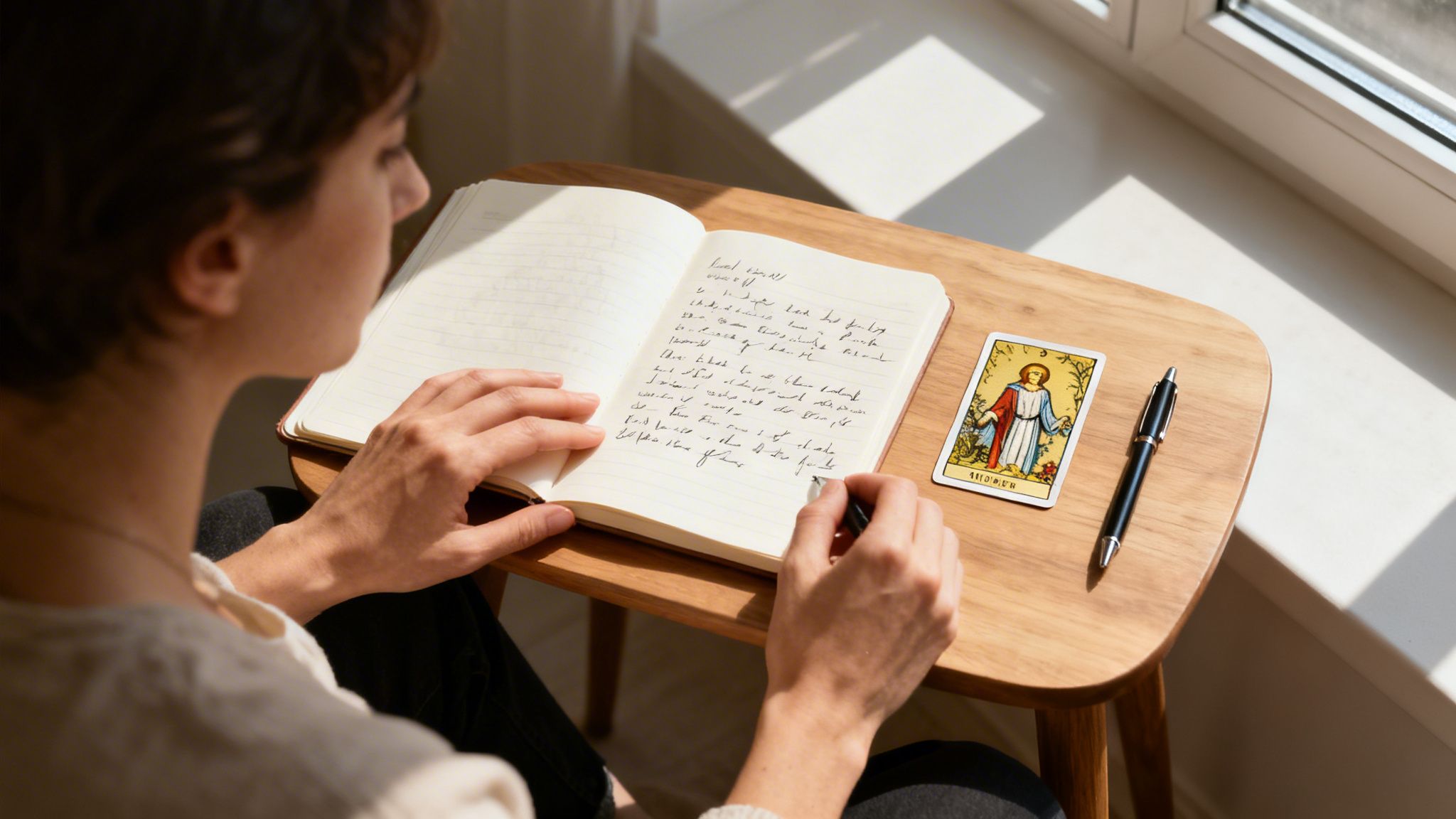
Then, grab a journal and use that card to answer a focused prompt. This is where the magic happens. You’re turning a fleeting thought into a concrete insight, building a library of your own emotional patterns over time.
- "What energy does this card ask me to notice in myself today?"
- "How does this card's message reframe a challenge I'm facing?"
- "If this card represents a part of my relationship, what is it trying to tell me?"
This consistent practice helps you spot emotional triggers before they get the best of you. It demystifies the tarot, turning it from a deck of cards into a practical, powerful tool for self-awareness.
From Symbol to Action
Let's say you're feeling anxious about a big presentation and you pull The Tower. Instead of seeing it as a prediction of doom, your self-awareness lens helps you reframe the message.
You might journal: "The Tower reflects my fear of this project falling apart. It's not a fact, it's a feeling. The card is asking me to look at what structures in my preparation are weak so I can reinforce them—not run away."
Suddenly, the card isn’t a scary prophecy. It’s a strategic prompt. It’s a mirror showing you your own fear and pointing you toward a solution.
By pulling one card each day, you build the muscle of interpreting your own inner landscape. That clarity gives you the power to navigate your career, relationships, and life with true intention.
Decoding Your Path in Love and Relationships
When you’re looking for answers about love, a single tarot card gives you a powerful snapshot. But the real story? That unfolds in the conversation happening between the cards.
To truly build self-awareness in your relationships, you have to look beyond individual card meanings and start reading the narrative they create together. This is how you move past simple answers and get to the heart of what’s really going on.
For example, pulling The Empress in a love reading is a fantastic sign. It speaks of nurturing, abundance, and creative potential. But then, right next to it, the Five of Cups appears. Suddenly, the energy shifts. The Five of Cups points to regret, loss, and focusing on what’s broken.
Together, they might be telling you that you’re in a relationship with incredible potential for growth and love (The Empress), but you’re so fixated on past hurts or what’s missing (Five of Cups) that you can’t see the beauty right in front of you. This is how you gain deep self-awareness—by seeing these nuanced dynamics at play.
Interpreting Complex Relationship Dynamics
The real power of tarot is its ability to mirror the tangled, often contradictory feelings we have in relationships. No connection is one-dimensional, and card pairings honor that complexity. They show us where our desires might be clashing with our fears, or where our actions don’t quite line up with our true intentions.
Here are a couple of classic pairings and what they can reveal:
The Lovers + The Devil: This is an intense one. It often points to a passionate connection that might be bordering on codependency or an unhealthy attachment. While The Lovers signifies a deep, soul-level bond, The Devil highlights temptation, obsession, and feeling trapped. It forces you to ask: "Is this connection built on genuine love, or a powerful but limiting addiction?"
The Moon + The Hermit: This combination is all about a period of deep, internal reflection concerning a relationship. The Moon brings up illusions, intuition, and hidden anxieties, while The Hermit is the ultimate archetype of soul-searching. Pulled together, they signal a need to withdraw from the relationship's noise to figure out what’s real and what’s just a projection of your fears. It’s a call to find clarity in solitude.
By looking at how cards influence each other, you get a much richer understanding of your own patterns. You can explore more of these intricate dynamics with our complete guide to love and relationship tarot readings.
Seeing how cards interact is like listening to a dialogue instead of a monologue. It allows you to understand the ‘why’ behind your feelings, not just the ‘what.’
This approach is a game-changer for using tarot to build self-awareness. It takes you beyond surface-level questions and straight into the core of your relational patterns.
Interpreting Key Card Combinations in Love Readings
This table shows how the meaning of a tarot card can shift based on the card it appears with, providing deeper insights for relationship questions. These combinations reveal the hidden layers behind your feelings and experiences.
| Card Combination | Potential Interpretation for Self-Awareness |
|---|---|
| The Empress + Five of Cups | You might be overlooking the abundant love in a relationship because you're focused on what's missing or what has been lost. |
| Ace of Cups + Seven of Swords | A new emotional beginning is present, but there may be dishonesty, avoidance, or a lack of full transparency holding it back. |
| Two of Cups + The Tower | A powerful partnership or connection is facing a sudden, disruptive change that could either break it or rebuild it on a stronger foundation. |
| Ten of Pentacles + Four of Swords | While you may have a stable, long-term family or relationship structure, there's a need for rest, retreat, and mental recuperation within it. |
Learning to spot these patterns is key. It helps you understand not just the situation, but your role within it, empowering you to make more conscious choices in your love life.
Navigating Your Career with Confidence and Insight
Feeling stuck, restless, or just plain uncertain about your professional life? You're not alone. That nagging feeling that something needs to change is common, but it's hard to know what to do when you can't put your finger on the problem. Tarot can be an incredible ally here, helping you translate those vague feelings into concrete, actionable insights.
For this, I love using a specialized "Career Crossroads" spread. Think of this simple five-card layout as a personal strategy session with your subconscious. It creates a framework to understand not just what you're doing, but why you feel the way you do about it.
Your Career Crossroads Spread
Each card position in this spread asks a direct question, building a story about your inner professional world. Here’s the breakdown:
- Card 1: Your Current Career Energy: This card is a snapshot of your present situation. It reflects your dominant feelings and the overall vibe of your job right now.
- Card 2: Your Hidden Professional Desire: This is where things get interesting. This card uncovers what you truly want from your career, which is often very different from what you think you should want.
- Card 3: The Obstacle You're Not Seeing: We all have blind spots. This card points to a subconscious block, a limiting belief, or an external challenge you’ve been overlooking.
- Card 4: The Skill You Need to Develop: This highlights a specific capacity—whether it's a practical skill or an emotional one, like setting boundaries—that will help you move forward.
- Card 5: Your Most Empowered Next Step: This is your takeaway. It provides a final piece of clear advice on the single most aligned action you can take right now.
Let's say you pull the Eight of Cups (which often means walking away to seek deeper meaning) for your Hidden Desire. Then, for the Skill You Need, you get the King of Swords (a card of intellectual clarity and sharp communication).
This combination tells a powerful story. Your job dissatisfaction probably isn't about the money or the title. It’s a soul-deep need for more purpose. The cards are nudging you to think logically and communicate your needs with precision to finally find work that feels right.
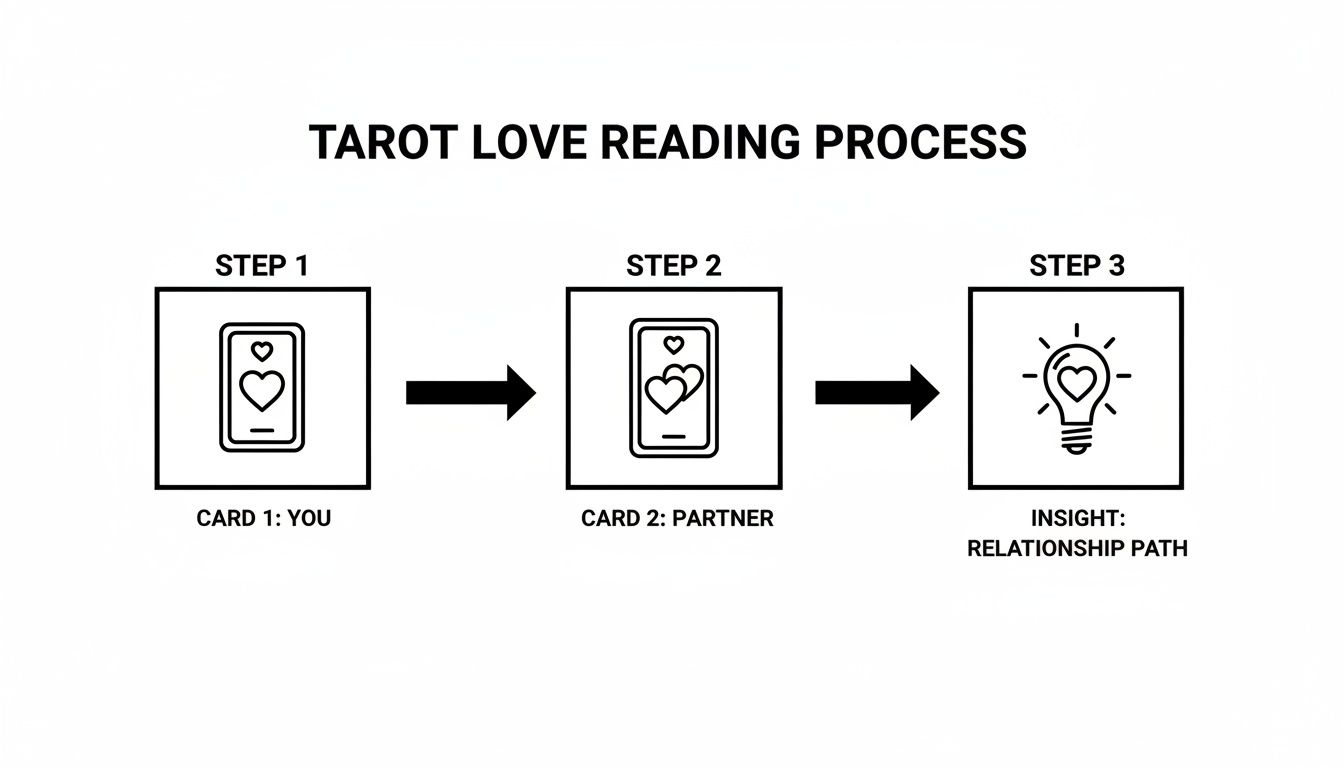
Laying out the cards in a sequence like this creates a narrative. It connects where you are now to a potential insight, turning abstract symbols into your personal guide.
From Vague Feelings to Actionable Plans
This idea of tracking your inner state isn't just for tarot. Modern wellness is catching on, too. For example, some career-focused executives are now using biomarker testing to reveal how stress impacts their choices. In fact, 55% reported making better decisions after tracking this kind of data. You can read the full research about self-improvement trends on yourstory.com. Tarot works in a similar way—it's a tool for checking in and revealing your internal patterns so you can make more conscious, informed moves.
The goal is to transform that restless feeling of "I need a change" into a specific, actionable plan. It's about pinpointing whether you need a new role, a new industry, or simply a new mindset.
Of course, to truly navigate your career with authority, you have to build self-confidence. Using spreads like the Career Crossroads is a foundational step because it helps you understand your own strengths and desires. Once you know what you truly want, you can start building the assurance to go after it.
For more targeted guidance, you might also find our dedicated career tarot readings helpful.
Using Digital Tarot for Mindful Reflection
In our always-on world, it’s easy to feel overwhelmed by digital noise. But what if we could use the very tools that distract us to find a moment of genuine clarity?
When used with intention, a digital tool like Lotus Tarot isn't just another app—it becomes a space for quiet reflection. Instead of pulling cards on autopilot, you can create a small, meaningful ritual that grounds you right where you are.
This idea taps into a larger shift toward mindful tech use. After hitting a peak of digital burnout, many of us are searching for more deliberate habits. It’s a real movement—by 2026, research suggests these practices will become the norm. Already, 65% of people are embracing 'conscious consumption' to combat digital fatigue, with some studies showing a 50% drop in screen time for those who try it. You can see more of these self-improvement trends on yourstory.com.
A Modern Ritual for Self-Awareness
Turning a digital tarot reading into a mindful practice is actually pretty simple. It’s all about shifting your mindset from just scrolling to actively engaging with your own intuition.
Here’s how to create a micro-dose of mindfulness before you even pull a card:
- Find Your Space: Before you open the website or app, just take a quiet moment. You don’t need a full-on altar—just a commitment to focus for a few minutes without being pulled away.
- Silence the Noise: Put your phone on 'Do Not Disturb.' Close out of other tabs. This small act tells your brain it’s time to shift gears and turn inward.
- Breathe and Ask: Take three deep, grounding breaths. As you settle, bring a specific, open-ended question to mind. Instead of asking, "Will I get the job?" try asking something like, "What energy should I bring to my career right now?"
By creating this intentional container, you turn a simple click into a powerful portal to your subconscious. It’s no longer an escape from your feelings but a direct path toward understanding them.
Reading Card Combinations Mindfully
Once the cards appear on your screen, pause. Before you rush to read the meanings, just look at the images. What thoughts or feelings come up for you right away?
Let's say you ask about a new relationship and pull the Ace of Cups (new love) next to the Seven of Swords (deception, avoidance). A quick, panicked interpretation might send you spiraling.
But if you look mindfully, you might see a different story. Maybe the combination isn't about someone else being deceptive. Perhaps the Seven of Swords reflects your own fear of vulnerability—the part of you that’s holding back and preventing the new love of the Ace of Cups from truly flowing.
This simple shift changes everything. Your digital tarot reading becomes less of a forecast and more of a deep, personal conversation, helping you build self-awareness one mindful click at a time.
Creating Your Long-Term Self-Awareness Toolkit
Think of self-awareness not as a destination you arrive at, but as a muscle you build over time. This toolkit is about creating a sustainable rhythm of reflection—one that doesn't feel like a chore but becomes a natural part of how you navigate your love life, career, and personal growth.
Let's build your personal self-awareness routine.
- Your Daily Anchor: Start each morning with a quick, single-card pull. Just five minutes is all you need. Ask the cards, "What energy do I need to be aware of today?" This simple act keeps you tuned in to your intuition, even when the day gets noisy.
- The Weekly Check-In: Once a week, set aside a little more time for a simple three-card spread. Use it to check in on a specific area of your life, like your career path or a relationship. This gives you a bird's-eye view, helping you spot patterns you might otherwise miss.
Tracking Your Progress and Avoiding Pitfalls
So, how do you know it’s actually working? You won’t get a report card, but you will notice real-world shifts. Are you responding more calmly to things that used to trigger you? Do your decisions feel less confusing and more aligned with what you truly want? These are the true signs of progress.
If you want a more structured way to see your growth, you can pair your tarot practice with a self-assessment method like the Wheel of Life tool.
It’s also critical to sidestep the common traps on this path. The biggest one is confirmation bias—only seeing the interpretations in the cards that confirm what you already believe. To fight this, always challenge yourself to find an alternative meaning, especially for cards that feel difficult or negative.
Another pitfall is leaning too heavily on tarot for every tiny decision.
Remember, the tarot is a mirror, not a crutch. Its job is to reflect your own inner wisdom back at you, helping you trust yourself more, not less.
This journey of self-discovery is also part of a much larger shift. The wellness market is now valued at a massive $2 trillion, thanks in large part to Gen Z, where 80% are committed to building preventative wellness habits. Looking ahead, experts predict that by 2026, 75% of self-improvement apps will weave AI-driven tools with intuitive practices like tarot. You can discover more about these wellness trends from the Global Wellness Institute.
Ultimately, building this toolkit is about designing a life that feels authentic to you. The real power isn't in the cards themselves—it's in the self-awareness you build by using them.
Frequently Asked Questions About Tarot for Self Awareness
When you dive into using tarot for self-discovery, questions are bound to pop up. It's a natural part of the process. Below are some of the most common questions I hear, with straightforward answers to help you start your journey with confidence.
How Often Should I Do a Reading for Myself?
For a daily check-in, a single-card draw each morning is incredibly powerful. Think of it as setting a theme or an intention for the day—it’s insightful without being overwhelming.
When you're wrestling with bigger questions around your career, love life, or a major decision, a more detailed spread once a week or whenever you hit a crossroads is more than enough. The real magic happens in the reflection, not in pulling cards over and over.
What if a Card's Meaning Doesn't Resonate with Me?
This is actually a fantastic opportunity for even deeper self-awareness. When a card feels "wrong," it’s often pointing directly to a blind spot.
Stop and ask yourself: "What part of this message am I resisting, and why?" It could be that your subconscious is picking up on something you haven't consciously acknowledged yet.
For example, you pull the Seven of Wands (defensiveness) on a day you feel totally open and relaxed. This might be your intuition's way of telling you that you need to protect your energy from something you haven't even noticed. Trust that feeling.
Remember, the tarot is a mirror. It doesn't dictate your reality; it reflects the energy you bring to the reading, including the subconscious feelings you may not have noticed yet.
How Should I Phrase My Questions for Better Answers?
This is key. To get truly insightful answers, you have to move beyond simple yes/no questions.
Instead of asking, "Will I find a new job?" try reframing it to: "What can I do to align myself with a more fulfilling career path?"
Open-ended questions like these invite guidance, not just a prediction. They put the power back in your hands by focusing on what you can actually control, turning your tarot practice into a proactive tool for personal growth.
Ready to explore what the cards have in store for you? Get immediate clarity with a free, on-demand reading from Lotus Tarot Reading at https://lotustarotreading.com.